Galleries

Photographic exhibition captures different views of city life

DSC_1243 mod 2

A small exhibition tucked away in the centre of Coventry celebrates city life in several different facets.

The exhibition, on the first floor of the Belgrade Theatre, is the work of 11 keen photographers, who each show three images under the title of City Life. They were challenged with interpreting that title to capture their city’s people, nightlife and environment, though some have chosen Birmingham or London instead of Coventry. It’s interesting to see the similarities and differences between the pictures.

Primary in city centre

Jim Harris pictured the large Primark building against a bright blue sky with the brutalist architecture and large open spaces in front giving it the stark appearance of an eastern European city in the communist era. Another shot looks down as two women sit separately near the escalator in the Upper Precinct, both alone with their thoughts or their phone. Jim said he was fascinated by the triangulation in the paving and an incongruous traffic cone (both works above).

Kim Slater’s images are attractive black and white ones of people walking on the cobbles of Hay Lane. In one, an old man looks at the ground, and in another a man looks down at his feet as if he’s stumbled, and another shot captures a walker at a lower level. She said it was only now they are on show together, she sees as well as the area which she likes, they all involve a concentration on people’s feet.

Skateboarder


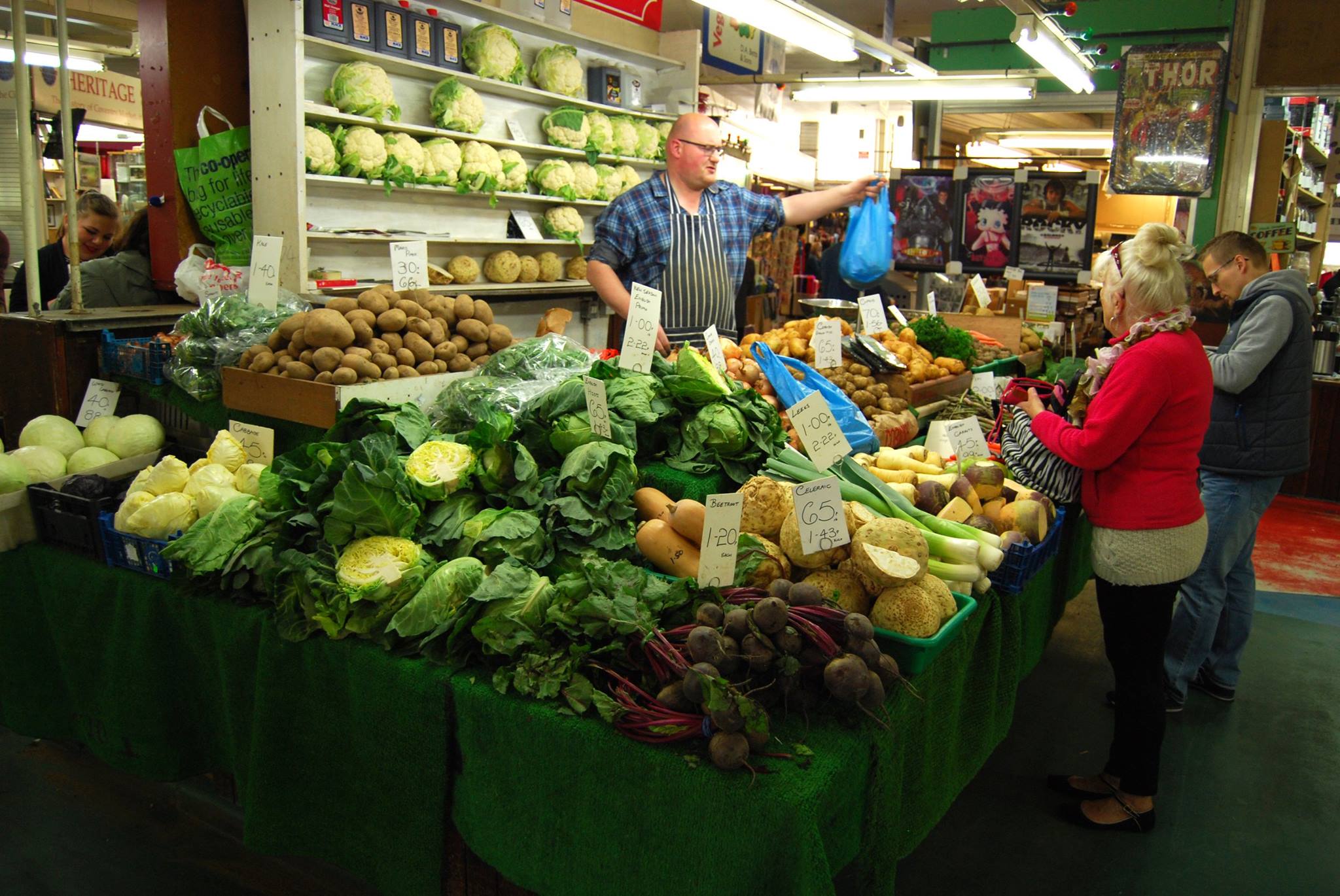
Tony Skipper has captured a colourful vegetable stall on the market, a street performer framed between passing pedestrians, and a cheeky monotone image of a young man, baseball cap pulled down as he poses with his skateboard next to a ‘no skateboarding’ sign (above and below).

Market stall

Tie

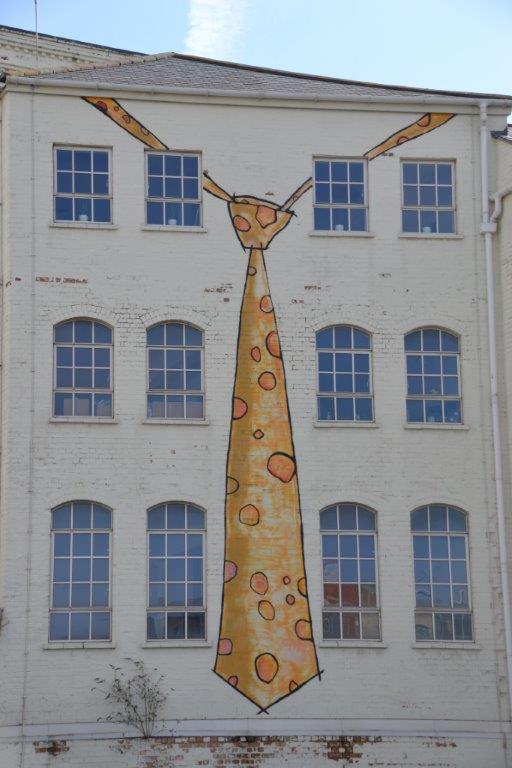
Rebekah Mason’s three images show dramatic graffiti art at the Custard Factory in Birmingham (one of them, left), and Maria Ahmad’s London photos include some pretty flowers, in front of a sleeping homeless man. Angela Haworth also concentrated on a London train station, taxis in a row and bicycles also lined up, while Craig Simpson’s three images show increasingly blurred images of buses going by, one cleverly capturing the bus framed between flashing beacons on opposite sides of the road.

Kelly Upton concentrated on the Flying Standard pub and the surrounding area in Coventry city centre, Caroline O’Hagan on grand buildings in Coventry and further away, Tommy Byatt on people and the area around the cathedral, and Magdalena Tomczyk has photographed night scenes of Coventry, which with the blurring lights make it more exciting than the reality.

All the photographers are evening class City and Guild Level 2 Photography & Photo Imaging students at City College, showing the high standard of work produced by the students taught in Simon Derry’s class. The exhibition is free, and on until June 20.


Don’t miss University of Warwick’s art collection on show at Mead

An exhibition not to miss is on for only a couple more weeks in Coventry.

Imagining a University: Fifty Years of the University of Warwick Art Collection is on at the Mead Gallery at the university until June 20.

I have already written about it in the Coventry Telegraph, but it also seems worth mentioning again alongside the book produced to go with it, which is a delight in its own right.

The book contains pictures of the university when the site had just a few buildings in open green fields, and art works in position from the early days. There are also many beautiful photographs of the works of art discussed. The book contains a series of essays by experts in the field which add a lot to our understanding of the foundation of the collection and the Mead Gallery.

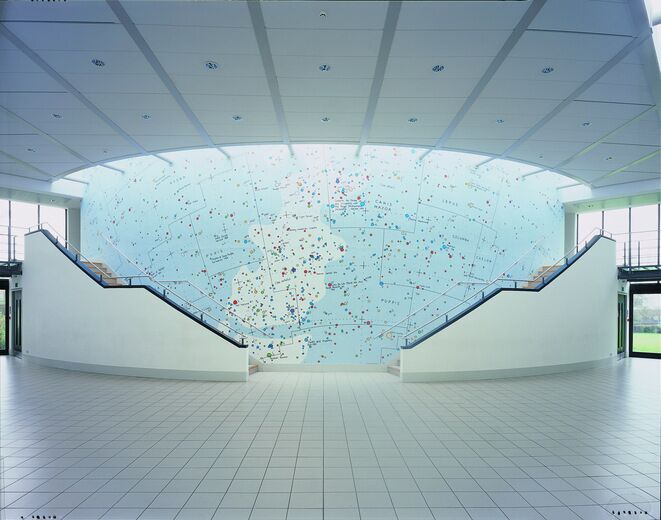
Simon Patterson, Cosmic Wallpaper, 2002, digital wa

Simon Patterson, Cosmic Wallpaper, 2002, digital wallpaper

Alan Powers writes what is logically the first chapter on The University of Warwick: the architect, the collector and the patron, which explains how it came to be built, the brutalist architecture and the founding of the collection.

The exhibition tells the story with Coventry Telegraph newspaper cuttings about the permission being given for the University of Warwick and six others to be established in the 1960s to provide higher education for a more socially diverse cohort of students.

Some of the first paintings are those discussed by Powers and by Beth Williamson in her chapter on Becoming a Collection. There are some of the nine huge, colourful abstract paintings given by Alistair McAlpine. Large abstracts dominate the first room, including two works by Patrick Heron, and one by John Hoyland, and one full of zig zag lines by Roger Barnard, who travelled from Japan to the exhibition opening, plus Terry Frost’s Red All Over.

Williamson discusses the difficulties that went with the decision for the collection to not be kept in a gallery or store room, but to be displayed around the place to add to everyone’s education. Along the way some pieces have regrettably been damaged, but others have become part of people’s daily lives.

Throughout this book, current and former member of staff and students explain the importance of individual pieces to them, sometimes as an irritant but more often something to gaze at for inspiration or to escape daily life.

In my own five years as a part-time Warwick student I remember several pieces in rooms in the humanities block, and when my mind wandered to them I knew it was time to concentrate harder on the seminar. Other works on library stairs had me causing a crush when I stopped to read the labels.

Later, as a part time university worker, I was delighted in my first office to have a Michael Rothenstein one side of the doorway and a Stanley Nolan the other; sadly an office move left me lacking that daily art. Visits to University House were a joy to see a Terry Frost, or Maggi Hambling’s portrait of a former VC on the way to a meeting room.

The exhibition gives a chance for everyone to see artworks from all over the University gathered together.

Screenprints and lithographs feature in one section, including Birmingham Race Riot by Warhol, and Roy Lichtenstein’s red and blue Sandwich and Soda. There are 12 Paolozzi screenprints inspired by Wittgenstein.

The exhibition moves on to a wall of screenprints and etchings, including works by Paula Rego, Babe Rainbow by Peter Blake, a Kitaj collage, and two small works by Coventry artist George Shaw, showing desolate garages and fence posts by a hedge, lacking a fence.

There are some works donated by Cyril Barrett, a Jesuit Priest and Reader in Philosophy at Warwick, including two boxed mixed media works by Harry Thubron. Other works came into the collection with the merger with Coventry College of Education in 1984, whose principal Joan Browne had collected paintings and ceramics.

A collection of land art works include The Wet Road by Richard Long, and Hamish Fulton’s Callanish, A Five Day, One Hundred Mile Walk photograph, as well as Andy Goldsworthy’s Bullrush Debris, a photograph created on site when he was the university’s first artist in residence. In the catalogue, former registrar Michael Shattock writes of focusing on this work during many meetings, and being grateful for then discovering the artist.

Newer additions to the collection include Hannah Starkey’s posed photograph of a woman with leftover office flowers in a bag, Olga Ivanova’s two photographs of people in Russia from a 2014 exhibition, and the painting Scenes from the Passion: The Swing, a George Shaw work showing nearby Tile Hill.

Other essays in the book cover the forming of the Mead Gallery in the 1980s, the development of the collection and site-specific installations, and its future.

Wherever it goes in the future, don’t miss the chance before June 20 to see so many fantastic works brought together in one place.

*The book, Imagining a University: Fifty Years of the University of Warwick Art Collection, is £18 or £25 after June 21. The exhibition is free to visit.

Coventry University degree show is full of art but has painting gone out of style?

Where have all the painters gone? That was what I was left wondering after visiting the Coventry University annual art degree show last night.

Over several floors, graduates showed their skills, from Foundation students fittingly in the basement to graphic design, illustration and fine art. It’s on the top floor where most of the paintings are usually to be found, and there were some, but not as many as expected. It’s a national trend according to a locally-based painter I spoke to later. The opening night seemed quieter than normal but on the plus side, there was a welcome return of lots of (cheap) free wine stations.

But anyway, what’s good to see about the degree show 2015, which continues in the Coventry University Graham Sutherland building on the corner of Gosford Street and Cox Street until Thursday. Photography is also only up the road in the Lanchester Gallery and Glass Box Gallery.

The Foundation students’ work seemed more interesting and better produced than I’ve seen for years, and is definitely worth a visit. Georgiana Irina Catana’s animation entitled Everything Remains Possible, with a little stuffed creature seemingly playing the piano was entertaining, and Tolu Olubrade’s Autonomic brought order to a china animal collection.

Rohanie Campbell-Thakoodun’s use of a polling box type device where people can confess a secret or confide their sorrows, and then shred it, was inventive, and Harjinder Rahore’s painting machine, using bicycle parts to create splattered T shirts was also fun. Testa Joseph’s Restriction in Freedom photographs combined bondage and fashion and Testa is off to Central St Martin’s next year to study fashion design. It’s always worth remembering George Shaw did his foundation year here before moving on.

Also on the ground floor, graduates who’ve created larger more sculptural items are showing. Myah V K Sahota has taken traditional pinafore designs and stitched them with more feminist slogans. Marc Evans was in a separate room and had the best hair of the night, possibly helped by taking a head set on and off again and trying to persuade other people to use it to literally light up the room with the power of their minds.

On the top floor, Camille Louise combined natural objects such as driftwood with weaved wool, and had a room full of sand with paint-splashed walls. Bethany Dartnell’s tiny and detailed drawings of flats in Birmingham were also interesting.

Muziwethu Nduma’s paintings were my favourite of the night, showing in a colourful, direct painting style, parts of Coventry that have become home, including a bus pulling into nearby Cox Street. The image in KFC was particularly arresting, the customer faceless with their back to the door and the two staff equally so, blocked by the customer or items.

I counted three people writing that their inspirations had included Tracey Emin, and one of them was Peige Smith, whose room had a parental guidance warning. In the corner one latex model of several penises dripped a white fluid into a metal bowl. She also referenced Helen Chadwick and Sarah Lucas, and the direct influence of both could be seen in the use of tights to create sexually-outspoken models of genitalia, and plaster casting of male and female genitals.

Eleanor Hudson’s black and white room was also interesting and detailed, and Chidera Ugada’s paintings, inspired by West African masquerades, stood out for their imagery and originality.

In the Lanchester Gallery, Oliver Wood’s The Farewell Train’s Last Whistle photographs of a former rail route were displayed in a interesting concertina way. Jenny Stonely explored the Anglo-Indian experience through portraits, and Ella Parkinson explores the state of dreams though some spooky self portraits.

These are the ones that stood out for me, so have a look and see who you think we should be seeing more of in future years.

Happy housing exhibition shows inspiring vision for post-war homes

Homes that would just create happiness – it sounds a great idea and one that people could relate to today, when for many a permanent home is just a dream.

But the happy homes plan was one that was on the drawing board back in 1945 in Bilston, and there’s still just time to see an exhibition telling the story of this wonderful and fascinating plan.

Bilston’s Happy Housing: Otto Neurath’s Vision for Post-War Modern Living is on at Bilston Craft Gallery until May 2 and tells the unlikely story of how someone from the Vienna Circle and a leading sociologist and urban planner ended up in the Black Country.

Neurath was invited by the council in 1945 to be a consultant on plans to come up with ideas to replace the slum housing endured by many of the local people, with the area having the reputation as the slum capital of England. What was envisaged were state-of-the-art modern homes based on ones built in Vienna in the 1920s.

Neurath was born in 1882, and had experienced a successful career in Europe, then fled during the Second World War after the death of his second wife, and fears for his life. He got married again, to Marie Reidemeister who he had formerly worked with, and after a period of internment on the Isle of Man they set up the Isotype Institute in Oxford together, creating the sort of informative diagrams now so loved by newspapers and news websites seeking pictorial ways to represent information.

However they were so taken with the Bilston project that they planned to move there from Oxford. Neurath visited the town and talked to people about their new planned homes, and wrote policies which influenced the designs. People should be mixed up to avoid the creation of ghettoes, and the needs of children and the elderly should not be ignored were two of them.

Then – Neurath died suddenly and unexpectedly on December 22, 1945; a poignant letter written on December 19 and illustrated with an elephant is exhibited, mentioning no signs of ill health.

Marie used the Isotype plan to illustrate her husband’s plans for the town, and in a letter to Bilston’s town clerk said he husband’s hope had been to “provide maximum happiness for the people of your town”.

There were of course many others also involved in the plans; Professor Sir Charles Reilly had also been engaged by the council, and favoured homes around large greens, with many community facilities. He died in early 1948 with the work still unfinished. Ella Briggs, another Viennese émigrée who had worked with Neurath, had already designed some homes before the two men became involved, and it may be the final results were based on her work. The uneven land was apparently filled in partly with bricks from bombed sites in Birmingham and Coventry.

The exhibition includes lots of information on the plans for what became the Stowlawn Estate, with drawings and the Isotypes. There are pictures of what had been there before, and plans for the homes, with inside bathrooms, some with upstairs balconies, and different sized properties to cater for single people and families. Drawings show the large open spaces around the estate.

There are also books of memories and photos, mostly positive, from people who were the first to move into Stowlawn. A related part of the exhibition shows the designs of the time for items which would fill these happy homes, with stylish cutlery, ceramics, furniture, fabrics, radios and other technology to represent the ‘new look’ of the mid century style.

Nearby, Stowlawn estate still exists and the exhibition tells you which is the only street where the green space remains as planned – the others have all been infilled with buildings. You can drive round and see how the buildings stand out as different, more European than most.

It’s a fascinating exhibition at an ideal which should still be grasped today.

Poignant performance for works of talented composers killed in Gallipoli


A First World War commemoration event with an interesting approach is taking place in Warwickshire this week. It will remember the artistic creation of two people who died in the war, and what might have been had they survived.

A press release from the Leamington Spa Art Gallery & Museum explained that as part of the Gallipoli Music Memorial 2015, the gallery is hosting a free dance performance in the Royal Pump Rooms on Wednesday, 29 April from 6-7pm.

The London Central School of Ballet will perform The Comic Spirit, a short ballet by the Leamington-born pianist, organist, critic and composer William Denis Browne. This will be the first public performance of the ballet, which Browne wrote in 1912.

There will also be the first solo dance setting of Frederick ‘Cleg’ Kelly’s Elegy for Strings: in memoriam Rupert Brooke. An introduction to the performances will be given by Nick Peacey, William Denis Browne’s great-nephew.

Senior Curator Vicki Slade said: “William Denis Browne had a promising career as a composer before the First World War broke out. 100 years after his death at Gallipoli, it is fitting that the first ever performance of his only ballet should be given in his home town.”

This event is free, though places are limited. They must be booked by phoning Leamington Spa Art Gallery & Museum on 01926 742700, or calling in beforehand.

This event runs in conjunction with Leamington Spa Art Gallery & Museum’s exhibition A Leamington Musical Meteor: The Life of William Denis Browne (1888-1915) which runs until Sunday, 10 May. The exhibition, which was organised by Nick Peacey for the Gallipoli Music Memorial 2015 project, brings together family archive material alongside compositions by Browne, to celebrate his career.

Browne was born in Leamington on 3 November 1888 and grew up at Lynnwood, a large house on Lillington Road. He attended Greyfriars Preparatory School in the town and Rugby School, before attaining classical scholarship to study at Clare College, Cambridge.

It was there that his talents developed as a performer and composer. After university he was building a successful musical career, with performances at 10 Downing Street and Westminster Cathedral, when the First World War intervened. Browne was killed fighting at Gallipoli on 4 June 1915, aged just 26.

*The Gallipoli Music Memorial 2015 is a unique project looking at the vastness of the First World War through one battle. It will tell the stories of nine men who fought at Gallipoli and will set their wartime experiences against their peacetime lives. All nine men pursued artistic careers, and although they fought for different causes, they were united by their experiences of the battle. The Gallipoli Music Memorial 2015 project is funded by the National Lottery through the Heritage Lottery Fund.


Faye Claridge’s Kern Baby is striking sight at Compton Verney this year

A haunting vision greets visitors to Compton Verney art gallery in South Warwickshire all this year.

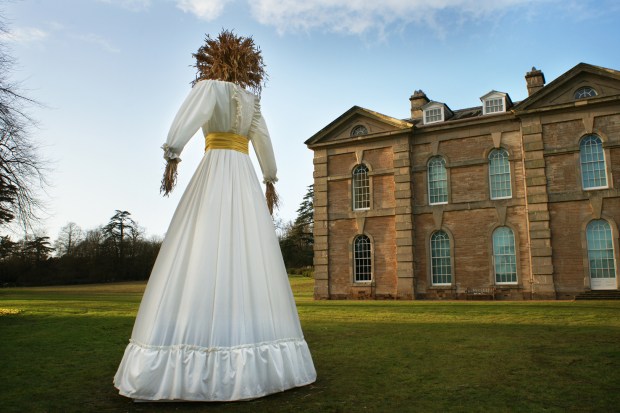
Kern Baby is the creation of Warwickshire-based artist Faye Claridge. She stands five metres tall, wears a long white gown – and has just wheat for her hands and head. The lack of a face as you approach and realize there is none there is the most striking thing.

The installation is backed up by an exhibition in the café area at the gallery, which explains where she comes from. Faye has had a residency at Library of Birmingham where she was working on the Sir Benjamin Stone photograph collection. Stone was a former Birmingham MP and Mayor of Sutton Coldfield who also travelled widely in the UK to photograph important historical places, festivals and pageants to record them for future generations in the late 1800s and early 1900s.Thousands of his prints are at the V&A and in Birmingham.

Faye said growing up with her Morris dancer father and folk singer mother she can remember a book of Stone’s photographs in the house as they gained a temporary popularity in the 1970s. She said: “To me they are very much about personal identity. Painting was felt to be in decline and photography was the new way of capturing something that was going to be lost.”

One of Stone’s photographs was of a Kern Baby, or corn dolly, from a festival called The Harvest Home in Northumberland in 1901. The community celebrated the wheat harvest by using the last gathered crop to create a human shape dressed in good clothes, and called it the Kern Baby. It was then kept over winter, then buried the next year: “It was buried in the first ploughing and planting in the new ground so the spirits of harvest went back in so she would grow again. I decided it should be revived.”

The work also chimes with the large British Folk Art collection at Compton Verney, and with the “Britishness” theme of the first two other new exhibitions of the year, Canaletto: Celebrating Britain, and The Non-Conformists, photographs by Martin Parr of Hebden Bridge in the 1970s.

The tall Kern Baby can be seen from the distance as you approach the gallery, and from a distance looks like she’s just escaped the building. She’s striking and unsettling, and worth circling to see from all angles and against different backdrops, some including the house and others just the trees and lake.

The structure is Faye’s biggest work to date, and involves more than 30 metres of theatre-grade polyester in the dress, which she sewed herself “on my ancient sewing machine”, and later added an underskirt as the structure underneath could be seen too easily. There is a yellow sash to reference the oilseed rape so prevalent these days.

The metal and water tank ballast which holds her in place was made with the help of a structural engineer and theatre design company, and she took four people six hours to put in place. It is hoped she will withstand the weather between now and December, though she will weather a bit and some wheat might be replaced.

Ironically, the Kern Doll was not conceived as the main part of the exhibition.

In the exhibition, Benjamin Stone’s photo The Harvest Home, Kern Baby, from 1901 is shown, a three foot white-clad figure in a plant bed, and Faye’s is a much bigger version of it. There is also an image of children holding hands around a huge pile of wood, entitled Northumberland Baal Fires: St John’s Eve, the prepared faggots, in what looks like a very strange scene from 1903.

Faye said: “I decided it would be fun to make a great prop to produce a new photo and to create a sculpture, but it was incredibly naïve but it got commissioned. I’ve done nothing on this scale before.”

She has though involved local schoolchildren from Welcombe Hills School and Hampton Lucy C of E primary to make her own version of the photo, with the uniform-clad youngsters solemnly surrounding the Kern Baby on a cold February day at Compton Verney. The photo was taken after working with them so they weren’t spooked by it.

She said: “My children (aged three and five) saw it when it was going dark and it was a full moon and she did look pretty ethereal.”

They gripped her hands tight, asked why she didn’t have a face and turned down an offer to touch!

Other photographs of Faye’s in the exhibition come under the title of A Child for Sacrifice, again inspired by Stone and photographs he took of youngsters in the Warwick pageant, and of the Wroth Silver ceremony. These depict youngsters from Marton, in Warwickshire, posing for her camera. Faye received a Heritage Lottery Fund grant to work with Marton’s Museum of Country Bygones to use some off their items to recreate pictures by Benjamin Stone.

These are the ones, when I’m trying to find the right word, Faye suggests are “edgy”, though parents were always on hand, and the children photographed picked their costumes. It is their confidence in strange garb and poses which is quite unsettling.

In one, a girl sits on a throne in a cornfield, corn sceptre and orb in hand, and in some she has lace obscuring her face. A boy becomes a scarecrow with a blacked-up face, and another boy in Plough’s Demon has some anonymous arms reaching round him. Another very young boy in a field is Faye’s own son.

The Kern Baby is immediately impressive and striking in the landscape but the Stone photos, the stories behind them and Faye’s own photographs inside are also intriguing and throw out questions about traditions from the past and how we relate to them.

* Next year Kern Baby will get a new dress and go on show at Birmingham Library – changing her setting from rural to urban, and where visitors will be able to glide past her on escalators. Three showcases about Faye’s residency in the library are on show at the moment.

Coventry graduates among winners in New Art West Midlands 2015

Foremark Reservoir IIShufflebotham

New Art West Midlands is in its third year and getting your work into it is a prestigious draw for recent art graduates – last year 100,000 people are said to have visited the exhibition across three galleries.

This year there are four involved – the Herbert in Coventry, Birmingham Museum & Art Gallery, Wolverhampton Art Gallery and the Barber Institute of Fine Art, showing the work of 30 people in total. All have graduates in fine art from one of the West Midlands art schools in the past three years, with successful works chosen by artists John Newling and Bedwyr Williams, and art historian Amna Malik.

There are four Coventry University graduates showing in the exhibition, and I spoke to them at the opening in Birmingham.

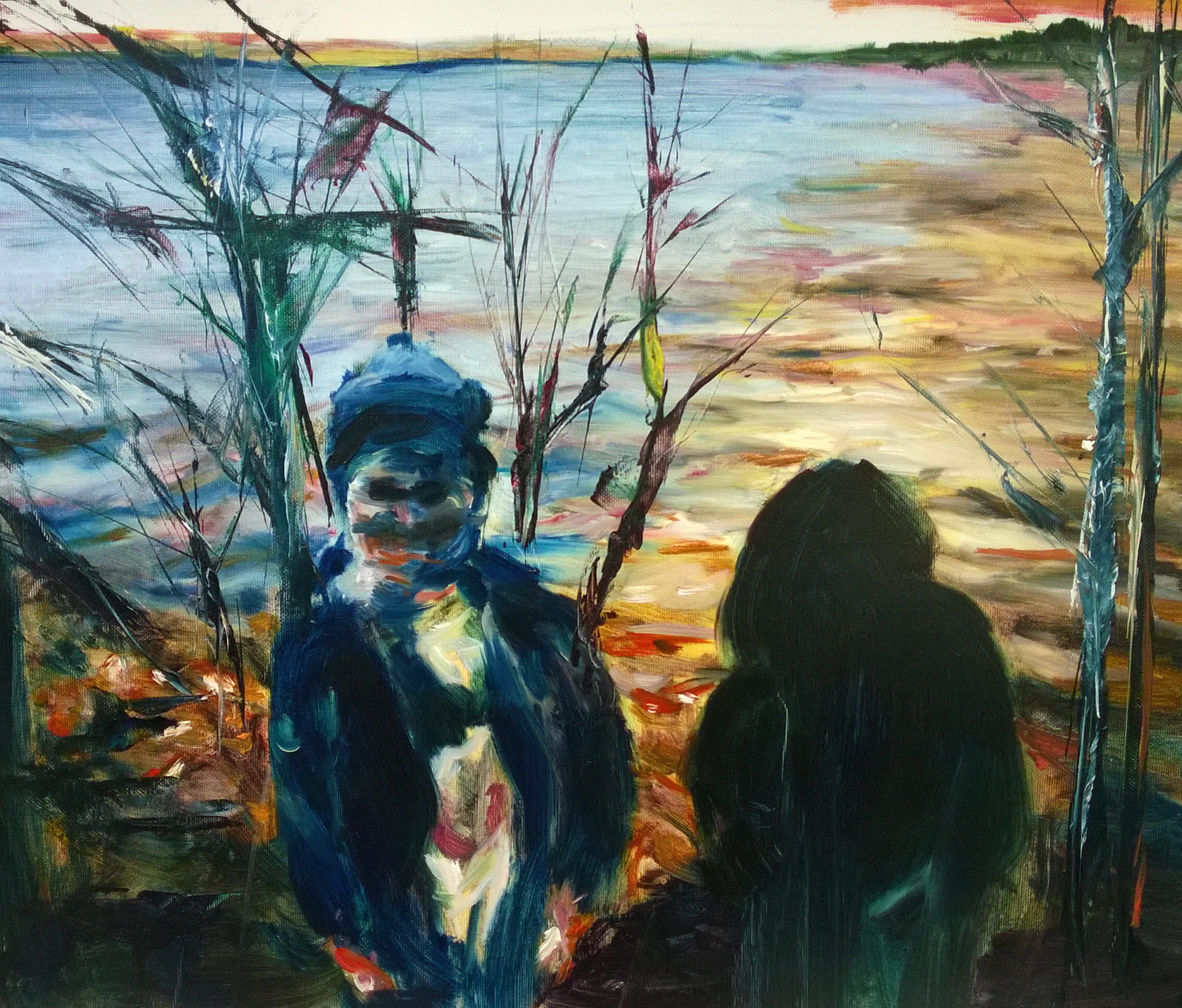
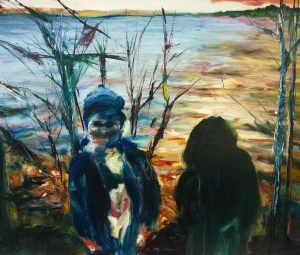
BA in Fine Art graduate Jennifer Shufflebotham’s work (top) had already been recognised before she was also selected for New Art West Midlands. She was offered a residency at the Pod in Coventry after her degree show last summer.

At the Birmingham gallery she I showing two paintings inspired by a box of slides she found in her grandparents’ attic in Burton on Trent about four years ago, showing family holidays in the 1960s, when photography was more of an effort than today when people can take pictures by taking their phone out.

She said: “I’d never come across them before and I was really interested in the balance of analogue photography and the easy access to photography and Instagram that we have today.”

She has re-layered them to create paintings, with blurred and slightly strange images produced. Foremark Reservoir II is particularly interesting, with one person reduced to a dark shape which could be deliberately cloaked.
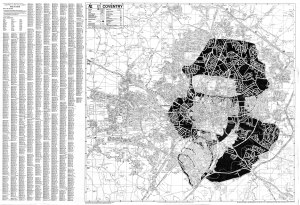
MichaelCarrMessagetoyourudy

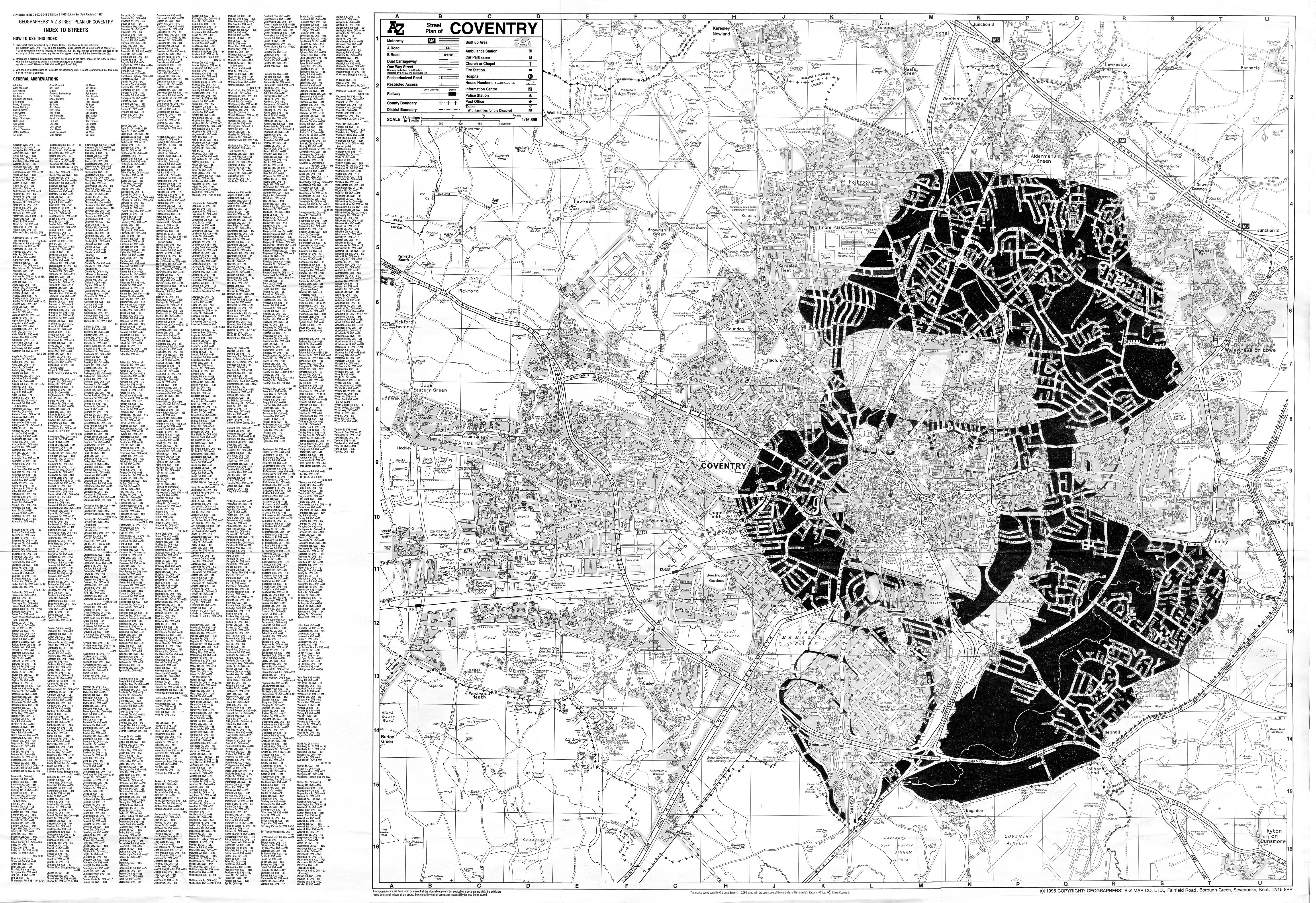
Michael Carr’s work includes Instructions Not Included, a screen print of the instructions for looking after a vinyl disc, and A Message To You Rudy (above), a digital ink work showing Lynval Golding from the Specials depicted on a street map of Coventry. If you pick up the exhibition leaflet you get your own copy of this.

Michael came into the world at the Walsgrave Hospital in Coventry and said music of the Specials had been “a big influence on my life”, and puts the work in the context of “a vision of psycho-geography and how music can motivate and change lives and people”.

He started this work with an illustration of Lady Godiva on a map: “The Specials and Lady Godiva testify to the strength of the city. A lot of people speak badly about Coventry but if you look at the invention of cars, sewing machines, watches and all its industry there’s a lot of strength there.”

Michael has just finished an MA in Contemporary Art Practice but his undergraduate degree was in graphic design, and he hopes to get a studio and have some links to the university still. I’d already seen his work at a couple of exhibitions in Coventry, showing he’s getting out there already, and with his energy and enthusiasm he’s sure to go places.
SONY DSC

Reece Kennedy’s work was inspired by talking to his Coventry University tutors about art education, studying, and the student’s audience. He chose to capture the paradigm of the art fair by creating an installation of a room from the Frieze art show entitled Greatness Engine Future Prospectus (above). Reece graduated with a BA in Fine Art and is running his own printing business in Birmingham.
SparkesAn Ode to Christian Joy

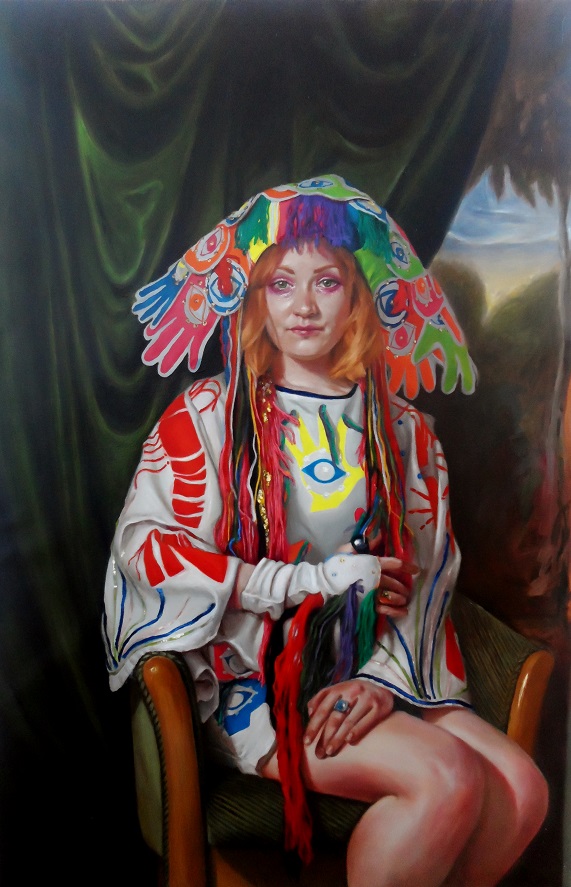
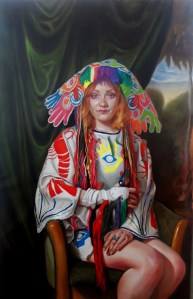
Other works on show at Birmingham Art Gallery & Museum included Emily Sparkes’s self-portrait in a colourful costume, Ode to Christian Joy (above), and she also has some paintings on show at the Herbert of Pearly Queens, relating to cross dressing and gender roles. They are interesting and keep the attention. James Turner’s reworking of paintings from the gallery’s collection sees beams of light coming from the painted women’s eyes, distorting how they are viewed and turning them into light box works.

At the Herbert in Coventry, Andrea Hannon is showing her installation works. Housekeeper is a lightshade with things hanging from it, and Territory Formula features flowered wallpaper and cut outs of women from magazines. Puppeteer includes more cut outs, an old framed mirror, and little character cut-outs, including a Victorian woman.

Coventry born and bred, Andrea has recently completed a Fine Art PhD at Coventry University. She used to do large paintings, but has now moved into multi-media installation and collage works.

She said: “It was during the masters I became interesting in structures of knowledge and how we become defined as one thing or another.”

She uses a lot of magazine and encyclopaedia images, and this set of work is based on the idea of what it means to be the ideal woman, as seen through the media, being good at cooking and housekeeping. Andrea has now moved to live near Stratford, and is teaching at the college there and working with some other former Coventry University students.
FishandChipsMeganSherida

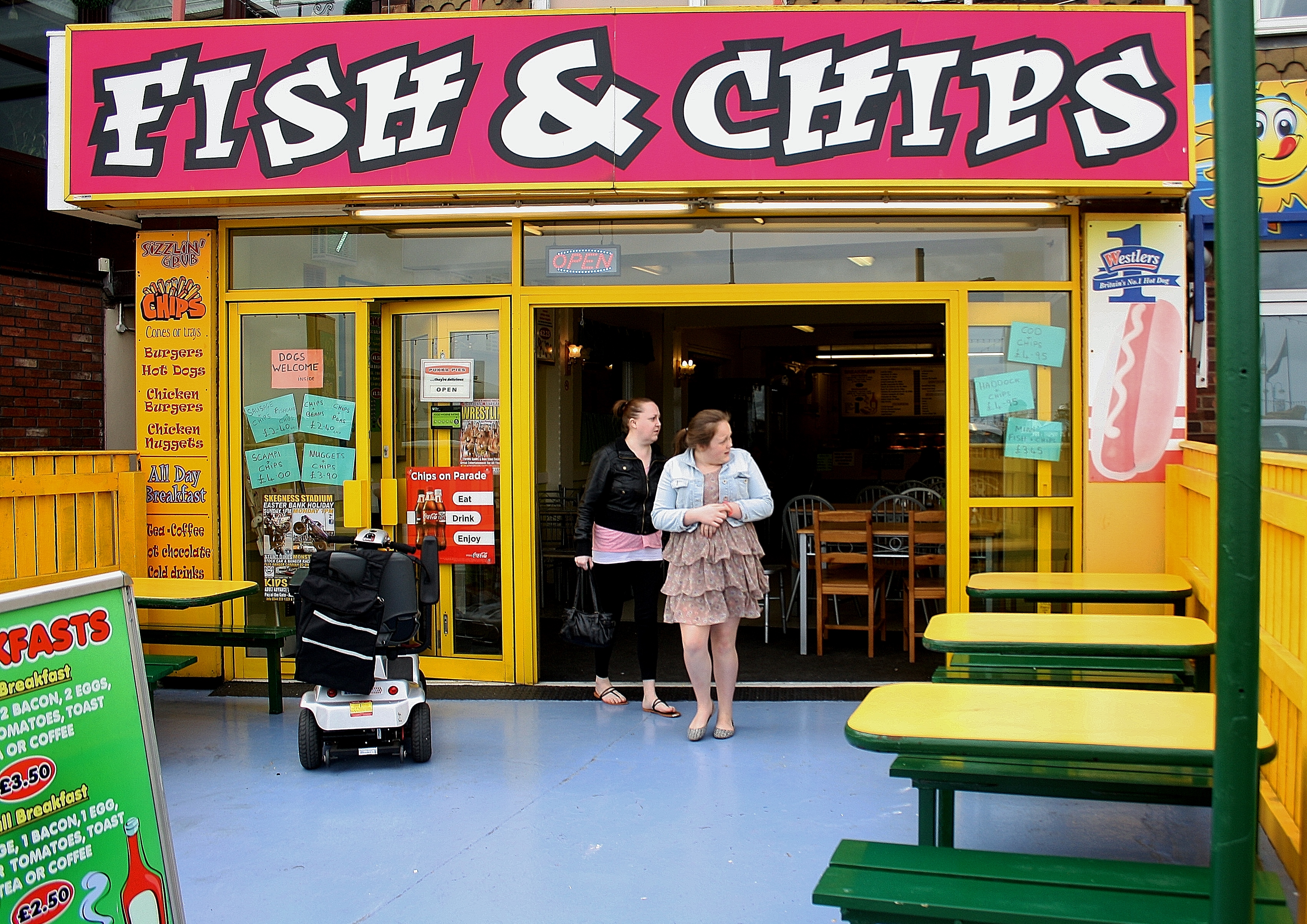
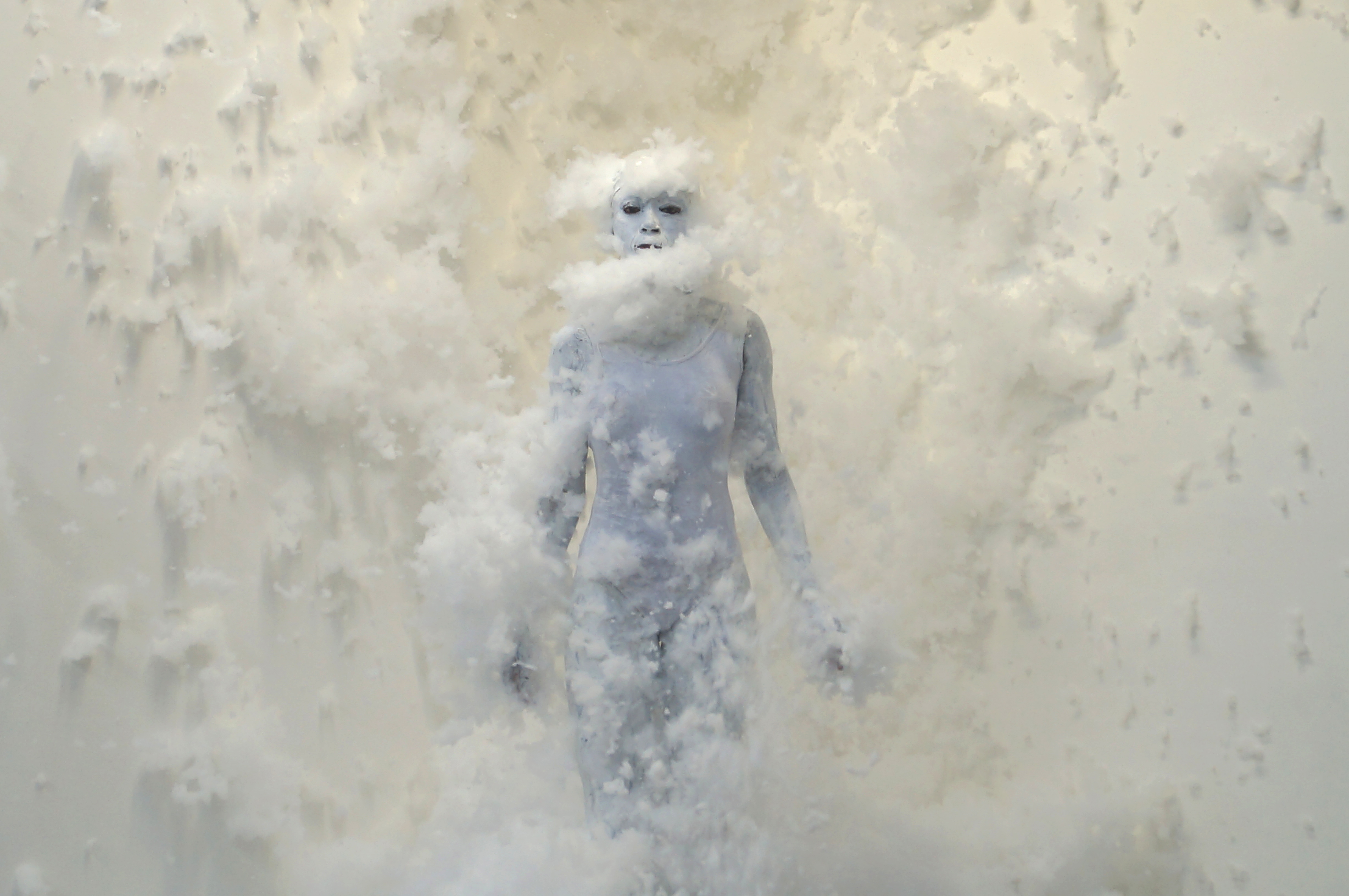
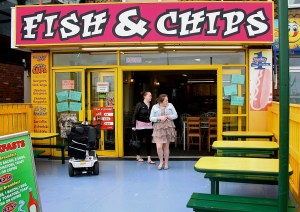
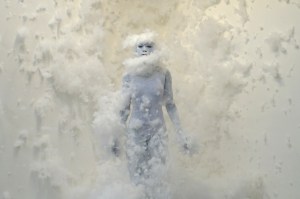
Also at the Herbert are varied works including Megan Sheridan’s documentary-style photographs depicting British people on a traditional seaside holiday (above), or having lunch on the grass in Birmingham’s St Philip’s Square. There’s also an intriguing video from Jade Blackstock entitled In, In, In (below), in which she wears white and paints her skin white and is then sprayed with white liquid foam, an unpleasant claustrophobic experience which aims to turn ‘white’ from an adjective to an actual object.
In In In

I’ve visited two of the galleries and at first sight haven’t been as impressed overall with the selection as last year. Maybe that’s because there’s nothing as stand-out impressive as Lucy Hutchinson’s masks and wallpaper, James Birkin’s paintings, or the transformative sculptures of Sikander Pervez, who is currently exhibiting at the New Art Gallery, Walsall, after being selected for a solo show.

But only time will tell whose work from the 2015 exhibition we will be seeing more of on a larger stage.

*New Art West Midlands is on at Wolverhampton until April 26, both the Birmingham galleries until May 17 and the Herbert until May 31.

Designer of Coventry post-war icons is featured in exhibition – discovered by chance in Leeds

So, my first ever visit to Leeds, for a job, but of course I had to get there early so I could visit the city art gallery.

And just as predictably for me when trying to explore new places, the upper galleries were closed for work, but a wander into the attached Henry Moore Institute produced a surprising and enjoyable find. An exhibition about the work of Dorothy Annan and Trevor Tennant whose work I had seen repeatedly over the last twenty-plus years without ever knowing it.

Everyone who’s ever stopped to look at the Godiva Clock in Broadgate will have seen Tennant’s work in the Godiva figure which rides out every hour, and the Peeping Tom which watches her. There is a lovely photo of a long-lost Broadgate with the Godiva statue facing the clock and people sitting on grass to watch it being unveiled.

If you turn the corner to Broadgate House, those are also his carved figures displayed on it. Entitled People of Coventry they are supposed to represent people in a timeless feeling of continuity, an important aspect to the post-war rebuilding of the city. Broadgate House was a key part of Donald Gibson’s plan for the rebuilding of the city centre, and included in the exhibition is some correspondence between architect and sculptor. There’s also a great picture of Tennant working on the relief figures on a blitzed site in London’s Regent Park.

He also created the Levelling Stone of the Phoenix which now resides in Coventry, and a brick carving of a falcon which is described as being on the side of a Coventry junior school – though it didn’t say which one.

A fascinating series of photos also show Tennant giving a sculpture demonstration at Coventry Training College in 1947, creating a model of a woman sitter’s head in front of a live audience, seemingly all male, who are also shown peering closely at the finished work.

Trevor Tennant and Dorothy Annan were members of Artists International Association (AIA), a left-wing group established in 1932 whose aim was “Unity of Artists for Peace, Democracy and Cultural Development’. They were based in Leamington during the Second World War where they were also members of the Artists and Designers Group and worked on public commissions, influenced by their membership of AIA.

Dorothy Annan’s post-war work included a mosaic entitled The Good Earth for the Rugby Road Junior School in Leamington, an oil on brick mural design produced by the Artists and Designers Group, and showing a combination of industrial and pastoral scenes.

There are also images of her designs for the Neptune Tea Bar and another room at the Finham Park Hostel in Coventry in 1942.

This exhibition also covers the pair’s commissions in London and other parts of the country. Their Dorothy Annan and Trevor Tennant archive joined the Henry Moore Institute Archive of Sculptors’ Papers in 2012, donated by their family. This exhibition brings together photographs, sketchbooks and exhibition catalogues to give a chronological account of their practices and show the role of art in British society post-war. It’s on until March 1 in the Upper Sculpture Study Gallery, and I was glad to have found it.

* I also visited Yorkshire Sculpture Park, though with a bit of a mist about it possibly wasn’t the best day for it. And luckily I had the wellies in the car as it was pretty muddy and slippy and I was mindful of a friend who fell and ended up with a broken arm after a visit! The whole site was too big for me to do it justice in the time I had, but I’d like to return another time. Enjoyed seeing several large Henry Moore sculptures in the landscape, plus Anthony Caro’s large Promenade row of sculptures, Ai Weiwei’s Iron Tree, which was outside the Chapel and Julian Opie’s Galloping Horse lightbox work racing through the gloom.

Inside the chapel was also Nick Crowe and Ian Rawlinson’s Song for Coal, an “immersive audio visual work” created to mark the 30 year anniversary of the miners’ strike. It’s pretty impressive as music and visuals combine to form a stained glass window appearance of miners and their lives on the chapel wall.

An island on the lake also caught my eye – loads of herons perched on nests and flying around, closer than I’ve ever seen them, and near enough to hear their flapping wings. It seems a great place to combine the man-made and the natural in a day out.

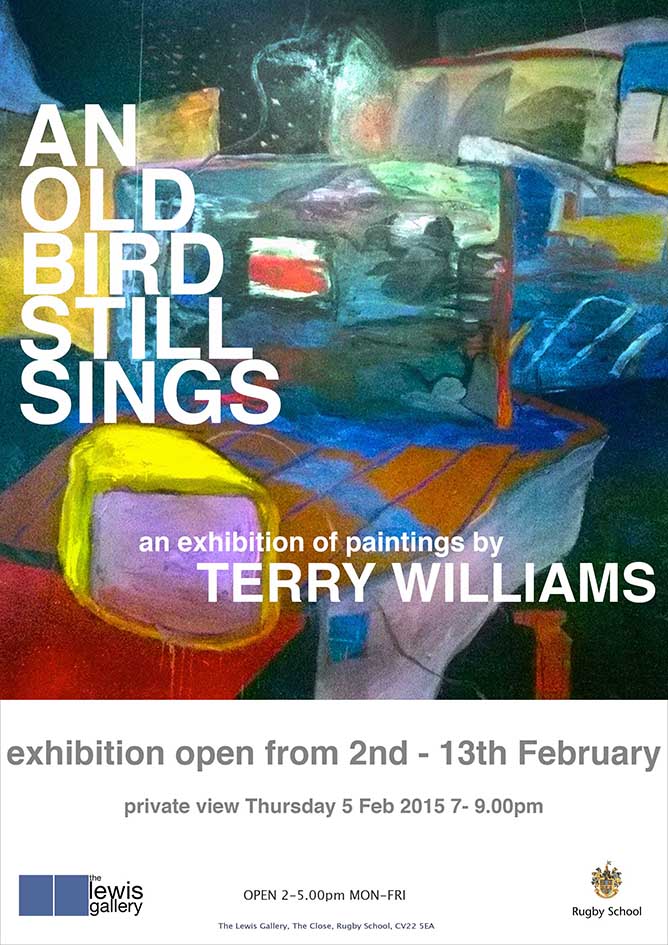
Cardboard ‘canvases’ are a feature of Terry Williams show at Lewis Gallery

         Terry Williams1

An unusual material forms the basis for a new set of paintings by Coventry-based Terry Williams.

Entitled An Old Bird Still Sings, the exhibition includes a number of works painted on what appears to be unfolded cardboard boxes.

Terry said he started off experimentally with the works, then decided they were good enough to keep and exhibit – but then of course began the problems with keeping them safe and in a condition to be displayed on the wall.

They were created at the Artspace Artists Studios in Lower Holyhead Road in Coventry city centre where he is the longest-lasting studio holder. He graduated from Coventry University’s Fine Art degree in the 1980s.

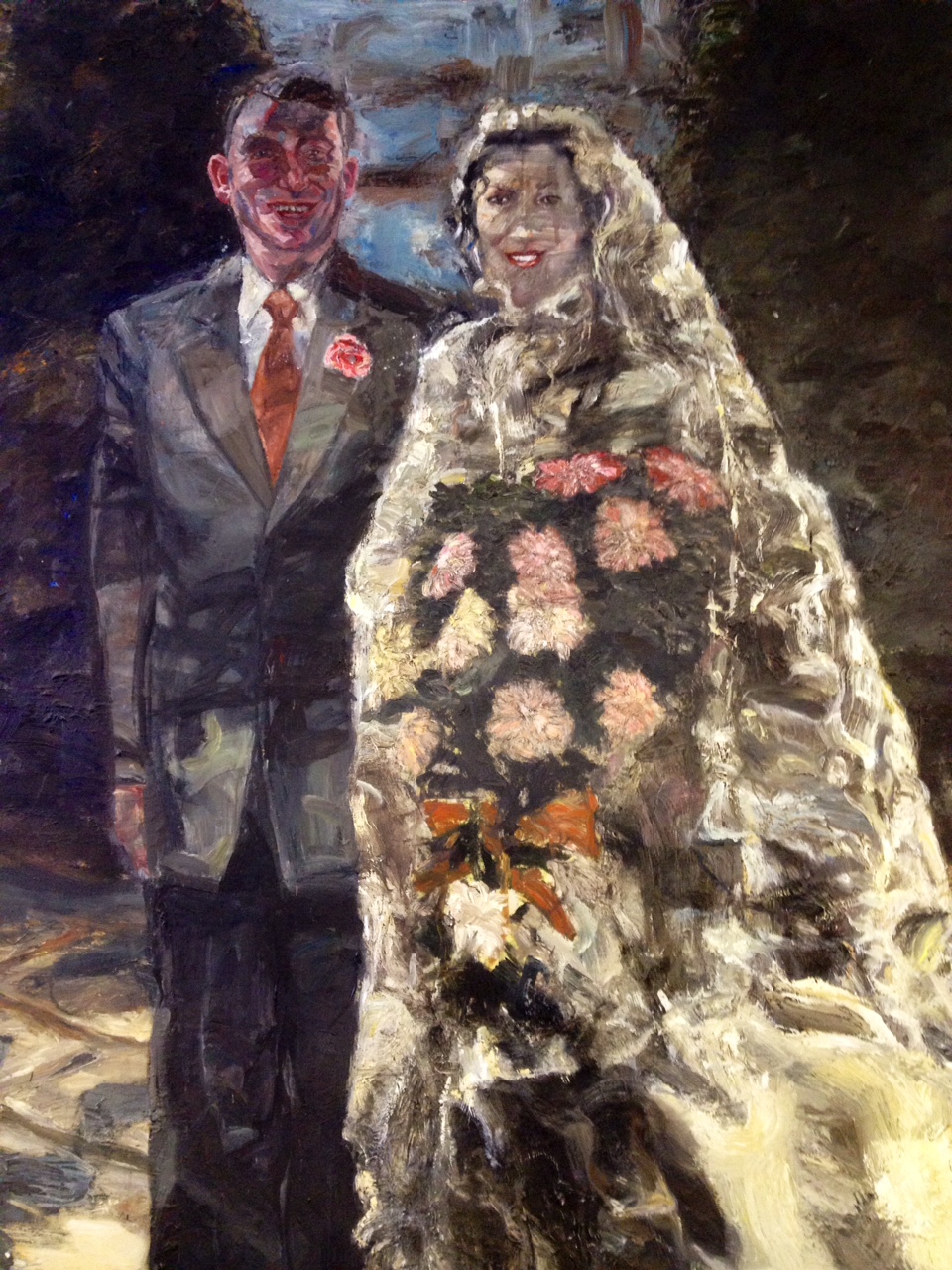
The cardboard-based works in question have an American feel to them – something that seems to be occurring a lot in Coventry and Warwickshire exhibitions recently. Using photographs from various sources, Terry has painted people at leisure, enjoying the sun. The rippling cardboard as the basis for some adds a depth of texture which works well with the ideas of sand and sea. Terry said they were part of a set where he wanted to capture people “in the midst of life”.

Some people are in rows of deckchairs on the beach, with plenty of sunglasses and overflowing swim suits on show, and one shows a cheerful couple in the sea, the man improbably dangling a fish he looks very pleased to have, and it’s called appropriately, Proud. A fat man from one of the pictures is shown in more than one image, including a facial close up, and Terry said he keeps returning to him for more works. A couple in a car, called To The Beach, have a stylish 50s look to them. Sunset shows children frolicking on the beach

Terry’s main interests are figurative, and these works are skilled and show an interest in capturing people at rest but in situations which when put in close focus do appear strange and rather unrelaxed.

Terry Williams2

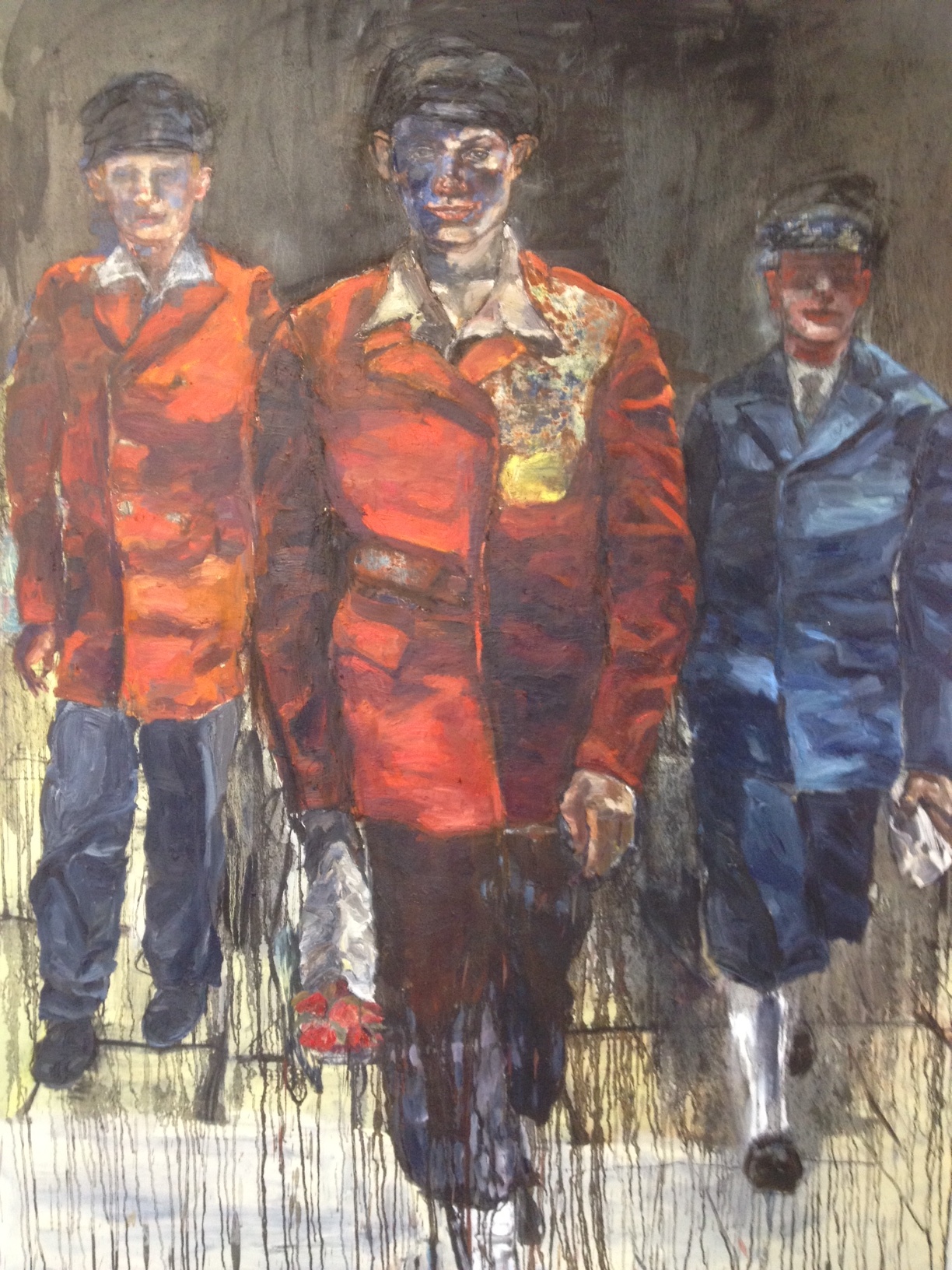
The exhibition also includes a set of works which have been on show before at the Pluspace Gallery in Coventry in 2012. There’s Cadet with Flag, then the same young man with Roses, Poppies and Brown Background.

Other works are more abstract, representing his other favoured style, lots with heavy impasto. Crazy Golf Mark One is a strange piece with what look like rocky islands bursting out of the sea with little golf flags on them. Fecundity Mark One, and Two, are two small abstracts which work well.

The title, An Old Bird Still Sings, comes from one particular work, which features a fairly abstract pile of computer hardware – but at the opening Terry said rather dryly that people had decided to interpret it as being rather a more personal title.

The exhibition fills the Lewis Gallery at Rugby School in Rugby, and the exhibition is on this week, 2-5pm.

terry williams jpeg poster

Nevinson war art shows fascinating creations of a rebel which enraged censors

If, like me, you’ve stayed clear of most things to do with commemorating the start of the First World War, you might like to change your mind where a current exhibition is concerned.

There’s only three more weeks left to see Rebel Visions, The War Art of CRW Nevinson at the Barber Institute of Fine Arts in Birmingham.  Complementing it though very different is German Expressionist Prints from the Barber Collection, another fine set of works which were exhibited and held up to derision by the Nazis in the 1930s, frightened of their brutal honesty and power.

The Nevinson exhibition tells his story, from being alienated as pretty much the only British Futurist on the outbreak of war, to not being able to fight on health grounds to subsequently serving as a driver and caring for injured soldiers, experiences which soon put him off the futurists’ glorification of war. He returned to France to create art officially though as this exhibition explains, some of his works did not meet with full approval; an oil painting entitled A Group of Soldiers was not thought to be heroic enough, and other works were censored.

Another work was partly inspired by his work in France, finding a barn full of injured soldiers who had not been treated for three weeks; The Doctor shows an injured man being treated next to one already dead beside him.

The works combine futurist and cubist techniques; there are sharp angles and limbs, pointed weapons and a geometric neatness to images of loss, horror and futility. A couple of gentle landscapes appear too, a contrast to The Road From Arras to Bapaume, showing the road disappearing into the distance through empty fields, a few walkers and vehicles on it.

Those who profiteered from war were a target for Nevinson, and he painted a man sitting contemplatively in his living room, the photo of a soldier behind him; it’s called He Gained a Fortune But He Gave A Son. In another, War Profiteers, artificial lights turn the faces of women made rich by war a deathly pale colour. Women are also pictured working for the war effort at home.

The painting The Unending Cult of Human Sacrifice is the stand-out work for me, combining images of war with religious iconography, planes and modern war technology, painted in the early 1930s and depicting his fear that another war was coming which would destroy Europe.

It’s a powerful exhibition of works from an artist who was clearly an interesting and complex person.

In another gallery, a small display of German expressionist prints from the Barber’s collection includes works by Max Beckmann, George Grosz and Egon Schiele. Depicting war, emotion, loss and Jesus they were all considered un-German in the 1930s and exhibited in a bid to create nationalist fervour against them.

Happily for us they survived as a sobering reminder of what should never be allowed to happen again.

*The CWR Nevinson exhibition is on until January 25.