Galleries

Look closely to find religion and sex in the suburbs in new George Shaw National Gallery show

The School of Love

The School of Love, 2015-2016, Enamel on canvas, © Courtesy : The Artist and Wilkinson Gallery, London

Allusions to paintings by great masters, and to seedy going on in the woods, combine for a fascinating new exhibition by George Shaw.

There’s also a set of fairly surprising new works that hit you when you walk in to My Back to Nature in the Sunley Room at the National Gallery.

Fourteen charcoal drawings entitled The Sadness of the Middle-Aged Life Model bring us a naked George in all his glory posing in the position of the stations of the cross, which he would have seen in the Catholic church of his upbringing. All the religious paintings in the National Gallery, where he has been Rootstein Hopkins Associate Artist for the past two and a half years, have clearly made quite an impression, though I remember a number of (less revealing) self portraits from his youth in his exhibition at The Herbert.

They create a good, surprising, introduction to the exhibition.
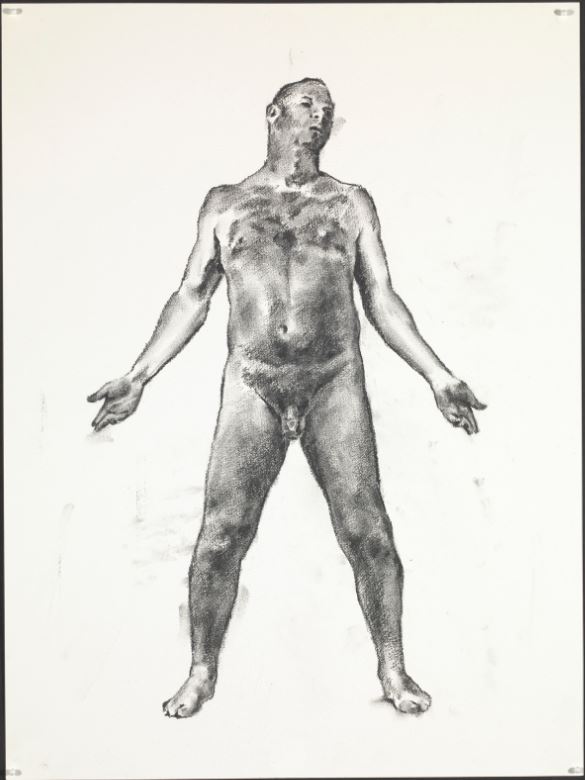
The Sadness of the Middle-Aged Life Model

The Sadness of the Middle-Aged Life Model (10), 2015, Charcoal on paper, © Courtesy : The Artist and Wilkinson Gallery, London

George said he found the National Gallery rooms nearly all contained scenes from woodland, women parading around and many had Jesus. So with the self-portraits, all three elements of that can be seen in this exhibition.

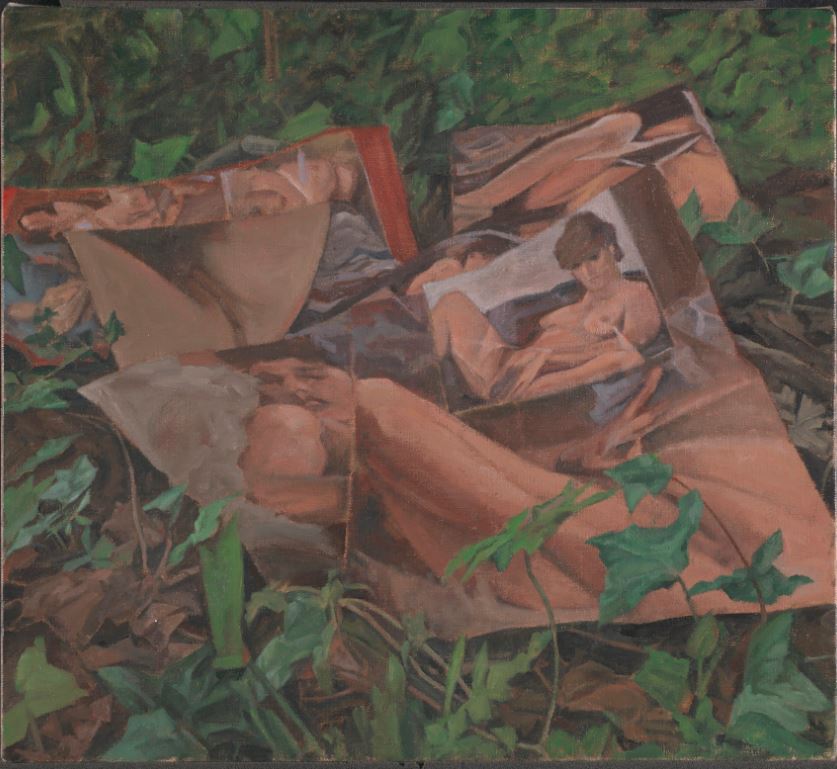
The paintings are a mixture of sizes, all in the usual Humbrol paint but with a move on to canvas rather than board. Thee Afternoons (Study for Drunken Silliness), The Tossed and The Lost are small works focusing on finds in the woods – abandoned colour pornographic photos, empty bottles, leaves concealing things.

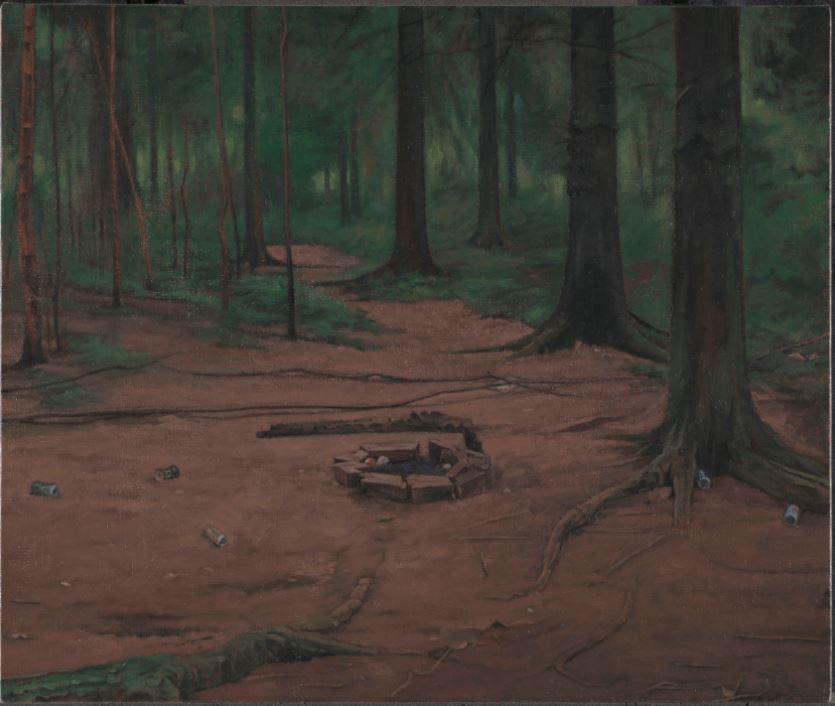
A Revel Before Half-Term features a large canvas with the trees standing darkly round, cans scattered about. The Heart of the Wood shows a small circle of bricks as well as the signs of recent partying; is it the base of a fire, or some more sinister black magic practices? The trees aren’t talking.

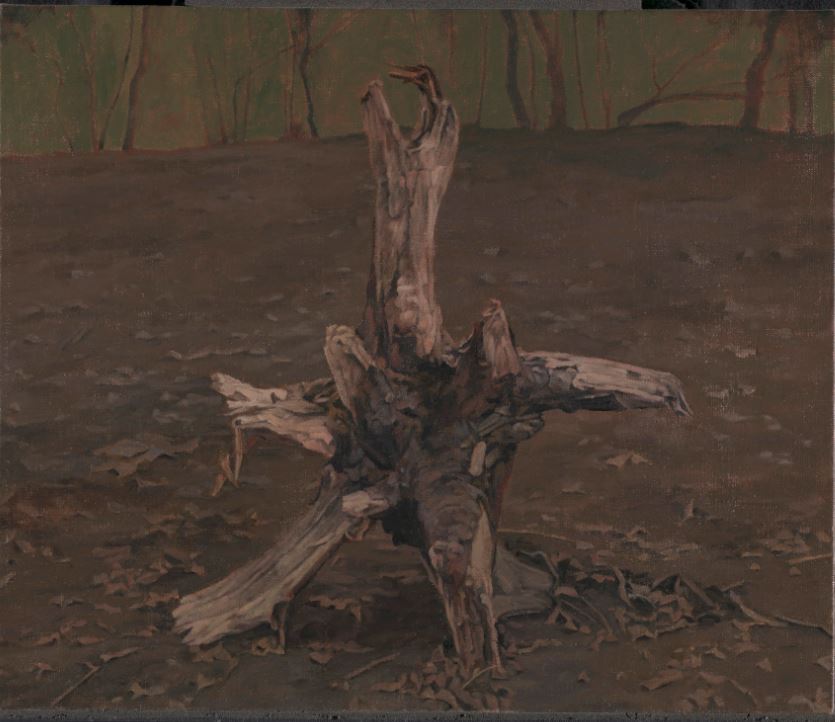
Studies for Hanging Around are three single trees, a reference to the crosses of the Crucifixion, and another clear influence from the residency, where he said he had become obsessed with the wood on the cross. The Foot of the Tree is a wooden stump left behind and Verso and Recto are reminiscent of some of his earlier works, with muddy paths leading away. The Uncovered Cover shows a blue cloth partly covered with leaves and concealing – anything or nothing?

The Old Master

The Old Master, 2015-2016, Enamel on canvas, © Courtesy : The Artist and Wilkinson Gallery, London

Another section of the gallery, George said at the press preview, he saw as the Adam and Eve corner.

The Old Master and The Old Country represent the male and female – or as George put it “someone’s gone into the woods and painted a cock on a tree – then there’s a very suggestive tree”. Ok ….

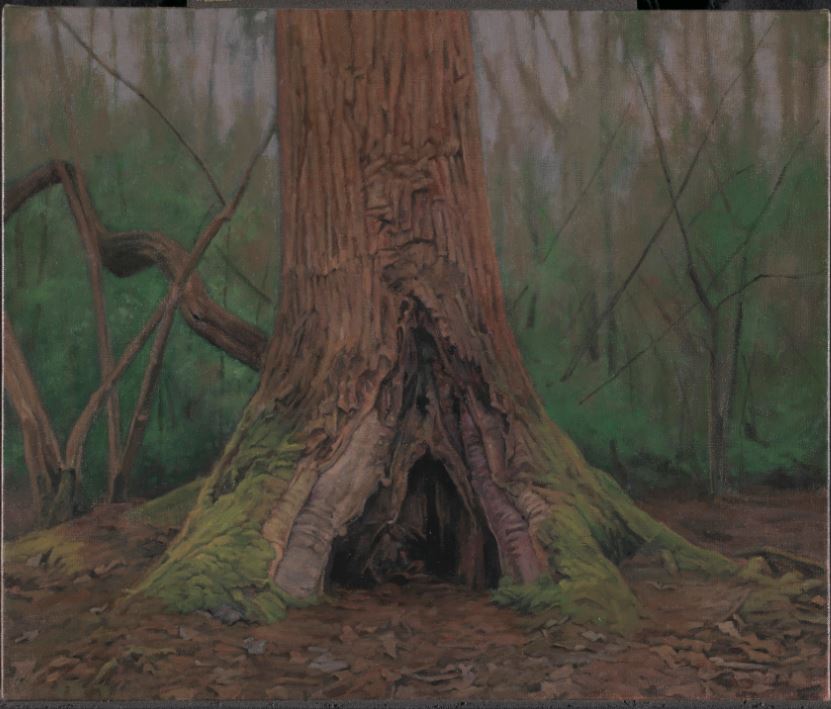
The graffiti is crudely and unnecessarily-added amongst the wooded scene, a reminder that it’s not in the depths of the woods but just yards from a Coventry housing estate. The tree has a deep, gaping crevice painted with care and attention.

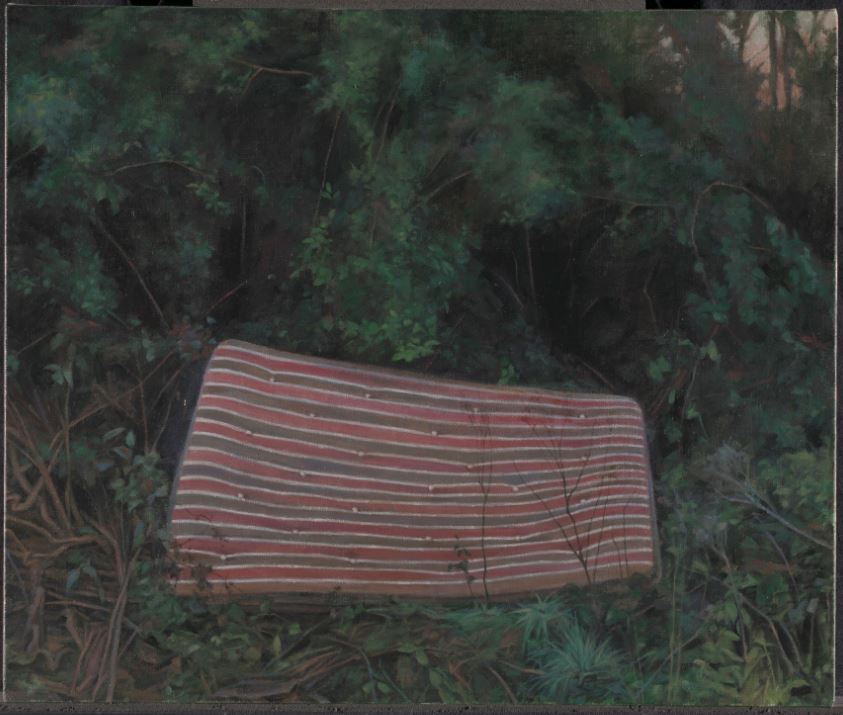
The School of Love is a painting of an abandoned mattress, dumped and unloved now, deep in the greenery.

Another work is an unusual self-portrait – George seen from behind up close to a tree: “I’m looking at the Observer Book of Moss,” he joked. “It’s called Call of Nature – what else?”

You’ve Changed is a set of nine small paintings of trees, all different, all with holes in their trunks somewhere, or cracked open; George referred to Youtube references to men who liked sexual liaisons with trees, finding the sexual in the suburbs.

George’s three paintings in the style of Titians Diana and Actaeon works command one wall.

A tarpaulin he found in the wood, hanging like a soft, sensuous material over one tree, represents the pulled-aside curtain, and the work is called The Rude Screen, a play on the rood screen which pre-reformation separated the church congregation from the priest.

The Rude Screen

The Rude Screen, 2015-2016, Enamel on canvas, © Courtesy : The Artist and Wilkinson Gallery, London

A hollybush stuffed full of pornographic pictures that he saw as a child – “I have no idea who put it there, it was almost like a branch of John Menzies” – was the inspiration for the painting representing the bathing beauties and is called Möcht’ ich zurücke wieder wanken . Hints of naked flesh and raised clothes can be seen on the images.

The third painting, representing the killing, is entitled Every Brush Stroke is Torn Out of My Body, and shows red paint randomly daubed on a tree, with another tree displaying a target. Again, it’s the imposition of the urban, peopled world into what is supposedly natural.

There is also a film of George at work at the gallery, talking about his influences, and visiting a wood (though unfortunately not the Tile Hill one), which is definitely worth seeing.

It’s a long time since we’ve seen a new body of work from Shaw but it’s been well worth the wait, and also made me eager to go back to some of his inspirations in the rest of the Gallery.


Great Masters and naughty goings on in the woods combine to great effect in George Shaw exhibition

The Foot of a Tree

The Foot of a Tree, 2015-2016, Enamel on canvas, © Courtesy : The Artist and Wilkinson Gallery, London

Two and a half years spent amidst some of the best art works in the country has resulted in a stunning new exhibition for Coventry-born artist George Shaw.

George has been the National Gallery’s Rootstein Hopkins Associate Artist – and the exhibition he has produced as a result shows the influence of time spent among the Old Masters, but also growing up in Coventry.

George’s paintings, which saw him nominated for the Turner Prize in 2011, focused on the urban landscapes of Tile Hill in Coventry, where he grew up, plus some of its back paths, semi-derelict garages and surrounding woods. Further works showed the remains of buildings such as pubs which have now been lost.

Here, there’s not a building in sight, but still plenty of evidence of human intervention in nature. The exhibition is called My Back to Nature, which can be read several ways, and is certainly a title George has thought about and played around with.

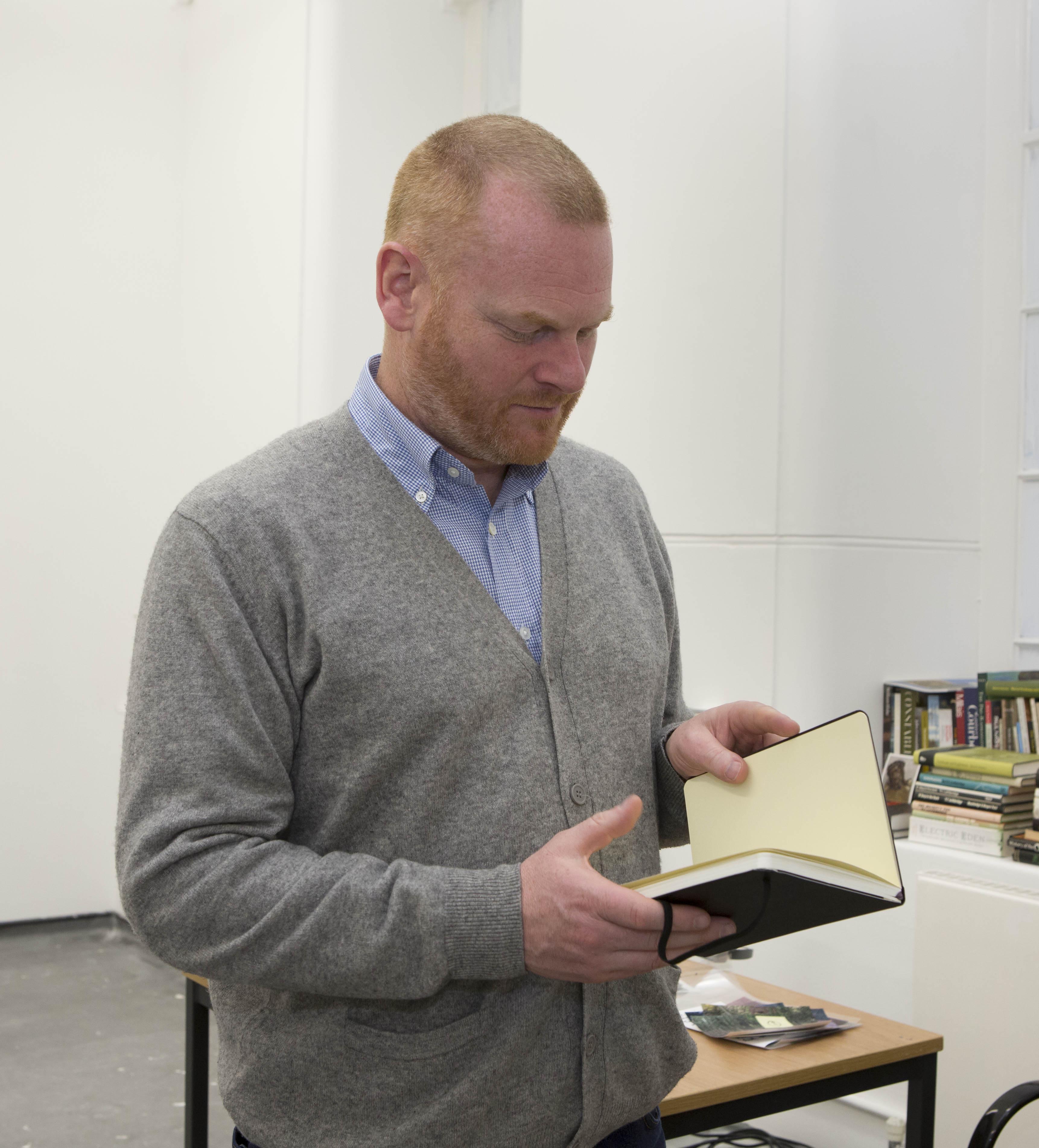
George

George Shaw in his studio, Photo © The National Gallery, London

At the press preview, the typically plain-speaking George talked about his first feelings at being asked to take on the residency. He said: “The initial reaction was complete mystification – how did I make the list. The second drove me to the toilet and I don’t think I have been off the toilet since.

“I spent about six months wishing I had never been asked. But I could hear a 14-year-old boy [himself] saying do it, that’s why you have been doing this for more than 30 years, or it’s been a waste. And I could hear my dad whirring round wherever he may be saying do it.

“It’s a very humbling experience, it’s like having your trousers pulled down in the shop window and you have to stay there. The bullshit of contemporary art slips away but you can’t hide behind vague theory, you have to be in the firing line.”

He shook his head, slightly in amazement still: “Setting up this exhibition, I had Velasquez staring at me – while I was pinning my drawing on the wall Velasquez was on the other side of the gallery.”

George had been a regular National Gallery visitor since he was a child. He said: “My first visit would have been when I was eight or nine years old and came down with mum and dad on the coach, walking through St James Park from Victoria, and my first stop was the National Gallery.

“My parents met in London and knew London quite well and they were aware that if you wanted to see art the National Gallery would be the place to come. We would have come here first then we would go to the newly-opened London Dungeon. I saw no distinction between the two.”

In one cabinet in the exhibition there is a drawing after a work by Piero Della Francesca, from 1984 – and when you remember George was born in 1966, then there’s the proof he’s been a long-time visitor.

He added that, like the 1970s cartoon character Mr Benn who always returned from a journey with a souvenir in his pocket, whenever he ventured away on an adventure to an art gallery, he would come home with a reminder in the shape of a drawing of a painting: “It was more I made a record of my time spent in front of the pictures. I am very aware of the anxiety of time passing, and I am aware my paintings and drawings are very about the sadness of time passing and sadness has a strong relationship with beauty. That’s where art lies, in the gap between sadness and beauty.”

In the Heart of the Wood

The Heart of the Wood, 2015-2016, Enamel on canvas, © Courtesy : The Artist and Wilkinson Gallery, London

George says in a film showing with the exhibition that he came into work every day like the other Gallery staff, but in his case to a studio to paint. Colin Wiggins, Special Projects Curator at the National Gallery, said in the film: “He’s got this pose that he’s just a working man, doing a working man’s job.”

But this job involved studying masterpieces, and he found unlikely connections with his previous inspirations in Tile Hill. One example he cited is The Triumph of Pan by Nicolas Poussin. As strange creatures and beasts frolic semi-naked, food and drink vessels lay abandoned on the ground; not dissimilar to scenes found on weekend mornings in Tile Hill woods, he thought.

He said: “I realised that there wasn’t a room in the gallery that didn’t have a woodland in it and there wasn’t one without a lady parading round in it, and very few that didn’t have a Jesus in it.

“It seemed to be the opposite of nature, to go into the woods take your clothes off and run around being half man and half animal and have sex with anything that will come along. I thought that quite exciting. I quite enjoyed the chance of that – I missed out on it when I was young because I was painting. I was never invited to that party.

“My return to nature was where I bring everything with me.”

The Tossed

The Tossed, Enamel on canvas, © Courtesy : The Artist and Wilkinson Gallery, London

He felt everything seemed to be happening on the outskirts of towns, in the woods, away from the culture. Along with scepticism about going back to nature to find yourself, he decided he had his back to nature – hence the exhibition’s title.

But how does he fit into the great tradition of British landscape painting, he was asked by National Gallery director Gabriele Finaldi.

“I was told I don’t. I don’t find landscape painting the most exciting part of painting, I find painting Jesus Christ being tortured on the cross, or sexual activity or nudes more exciting. The big question is why don’t I do that – because I can’t.”

He said the teenage boy who didn’t get invited to the exciting parties dreamt instead of being Van Gogh or Rembrandt, and he’s still striving for that, saying about this exhibition: “My reference point was six Rembrandt self-portraits, the way he painted them was the way I wanted to paint a tree.”

The more he looked at the National Gallery works, and the woods around Tile Hill, the more he started to use elements in the landscape figuratively and physically. Three trees together started to be the three crosses at the Crucifixion, at Calvary.

The young George had always loved Titian’s Death of Actaeon at the gallery, and by the time he became Associate Artist the gallery also had Diana and Actaeon and Diana and Callisto.

George said: “Death of Actaeon is one of the greatest paintings in the galleries and it’s one I go back and look at and it’s always impressed me on many different levels.

“I knew I wanted to deal with that subject in a way. I am drawn to the subject of the story.”

In the story, the hunter goes into the woods, finds a curtain which he pulls aside to reveal women bathing. One is Diana who turns him into a stag, and his own hounds devour him – and in the Titian painting she is seen raising a bow and arrow for good measure.

George added: “Maybe coming from Coventry the subject matter attracted me, the tradition of Lady Godiva protesting about taxes in the city and Peeping Tom has his eyes burnt out for being drawn to her.

“I went into the woods as a young man and my dad was pointing out all the finer points of flora and fauna and I was more drawn to the copies of Penthouse magazine blowing around. I thought I would come back later and get it.”

Every Brushstroke is Ripped From My Body

Every Brush Stroke is Torn Out of My Body, Enamel on canvas, © Courtesy : The Artist and Wilkinson Gallery, London

When George ordered three canvases, 178×198 cm, Gabriele said it only meant one thing – they were the same size at the Titian works, and he was going to create his own version. A chance find to take the place of the curtain helped.

“I found a builder’s tarpaulin in the wood. When I saw it I thought are you joking me, I feel I am being set up here.”

George still paints in the Humbrol enamel paints he started using about 20 years ago, and said they become unusable very quickly “It’s very difficult. I enjoy it – I don’t know if that’s really my Catholic upbringing, if you enjoy something it must be bad.”

The paintings are created from photographs, drawings of the same scene and then he varies what is there to suit what he wants, and said by working in the National Gallery he’s been glad to get away from the feeling of his photos bullying him.

He has also tried painting on canvas for the first time. “The gesture and mark making became a little more free form, shaking off my British anal retentiveness.”

In the film also on show at the exhibition he’s seen laughingly fretting about paint running on one of the big works, then he notices more: “It’s like Zulu, they are all coming!”

Most of the painting went on at the National Gallery studio, though there was quite a lot of travel between the “Bermuda Triangle” of London, his home in Devon and Coventry, and some of the smaller paintings travelled with him to be further worked on.

He revealed: “I don’t like my work. I wouldn’t have it because I always see it may be better. When I had about six months remaining here I wanted to be around for another year because I had not made a great painting yet.”

The exhibition is on in the Sunley Room at the National Gallery until October 30 for you to judge for yourself.

The Old Country

The Old Country, 2015-2016, Enamel on canvas, © Courtesy : The Artist and Wilkinson Gallery, London


Artists Workhouse is setting for abstract painting exhibition

A new-ish gallery space is showing an exhibition entitled Windows, and it brings together two artists I’ve met running galleries in different places.

The Artists Workhouse in Studley is being developed by Dawn Harris, an artist currently studying for her MA in Fine Art at Gloucester University, and who previously was artist in residence at Ragley Hall where she also became Director of Ragley Gallery and Studios. There were several fun openings there, where visitors drove up to the stately home to enjoy drinks in the luxuriant setting, and then visit the exhibition in the atmospheric stable block.

This show is curated by Matthew Macaulay, a Coventry University art graduate who amongst other things set up the Pluspace Gallery in Coventry which made use of an empty space overlooking Broadgate and showed some good exhibitions, before he went on to work under the Pluspace banner for various other projects.

But good things at Ragley and Coventry city centre both came to an end, and Dawn has now moved on to establish The Artists Studio in Studley, which is being promoted as “an artist-led studio, gallery and project space benefiting from a collaborative environment”, with studios, workshops, events and exhibitions. And as Matthew put it, he was curated to curate the exhibition there.

window -3-

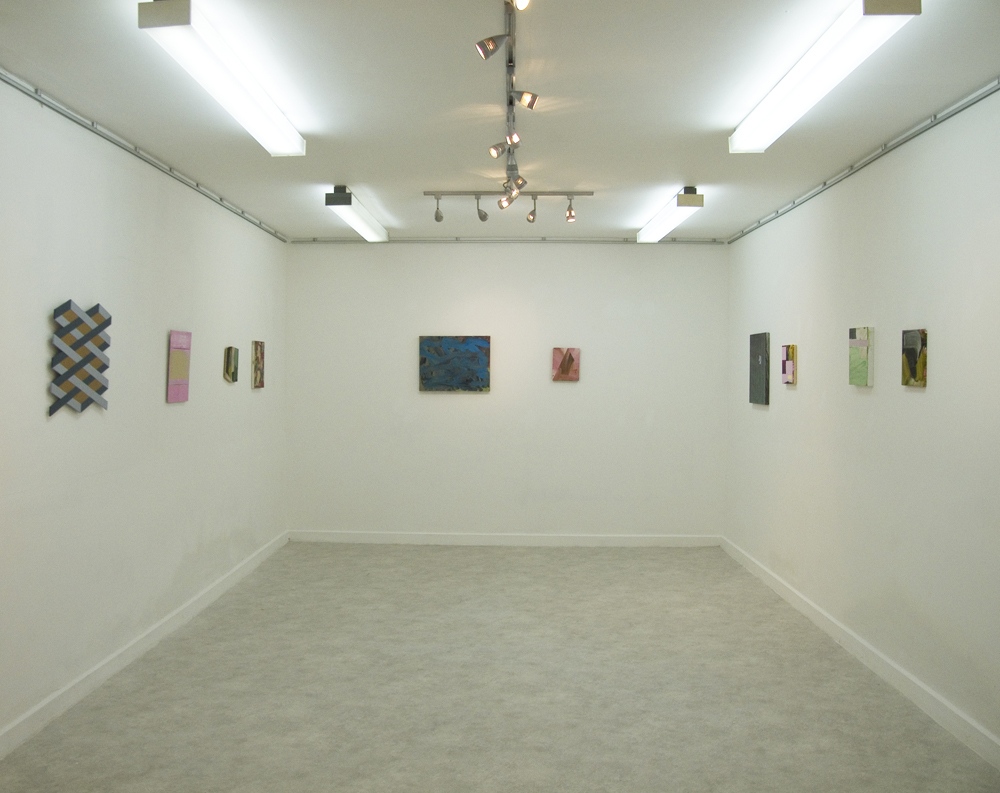
The show consists of 25 works by various artists from countries including the UK, Germany and Romania, and is over two floors at the venue.

The paintings are mostly abstracts, and include some by Matthew including the lagre and striking Southside (Lewis), a mostly-green abstract of his homeland.

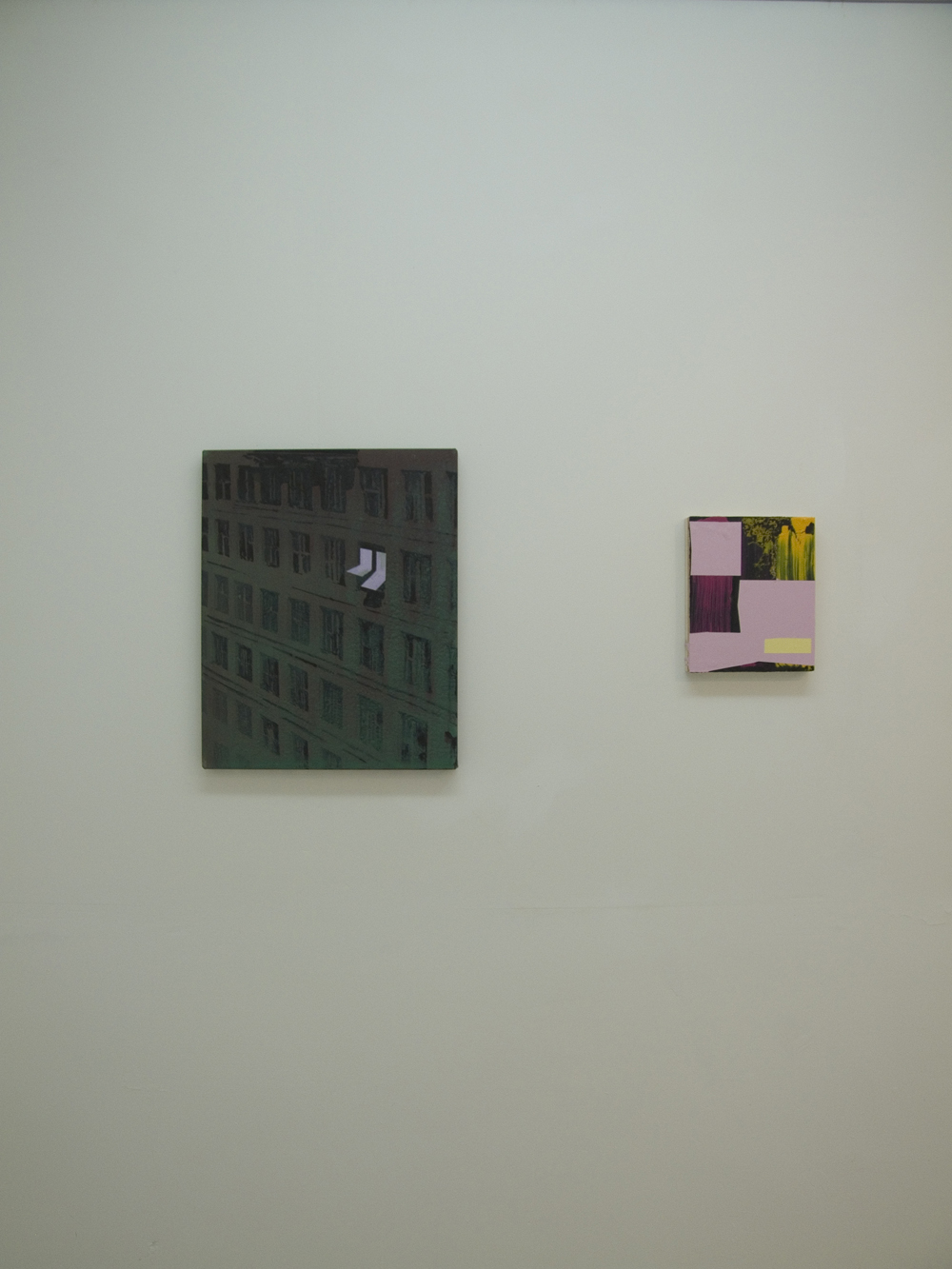
Three works by Coventry University lecturer Graham Chorlton actually feature windows in the paintings; in one, bright blinds seem to stick out of a dull-coloured building, and another looks like it’s painted from within a building in another country, with wooden blinds and attractive architectural buildings visible through it.

window -5-

New works by another Coventry University graduate Mircea Teleaga, now studying at the Slade, both called Untitled (Night Clouds) are also different to previous ones I’ve seen, with dark blue/black swirls of what could be water or clouds. Damir Sobota’s criss-cross stripes of colour are a big contrast. Terry Greene’s ‘Water s very important for life but we need it to wash our hands’ has the longest title but is a smallish work with a U shape in blue, and Erin Lawlor’s small works seem to consist of several large brush strokes.

It’s an interesting exhibition in a good new space.


From the ruins of ancient Rome to Coventry’s conceptual artists in one packed day in London

A day trip to London for a gig always means an early start and a late night for me, and the chance to fit in a few exhibitions.

I got around five this time, and they were certainly varied.

First stop, the British Museum for Francis Towne’s watercolours of Rome. Towne, who lived 1739-1816, visited Rome in 1780-81 and made a large selection of paintings of its famous landmarks and the surrounding countryside. He continued to work on them for many years afterwards, and some have clearly added extra pieces of paper on the side or bottom, with the scene continuing, or extra trees added later.

In the British Museum’s lovely cool print room with its muted lights the watercolours are lovely, delicate and somehow relaxing. However they were not really appreciated in Towne’s lifetime, though they were first displayed together in 1805; this is the second time. Towne tried several times to be admitted to the Royal Academy, but was always rejected; he was from Exeter and hated being seen as a provincial drawing teacher. Small comfort that we can now go and enjoy them and he is appreciated as a skilled watercolourist. The exhibition is on until August 14.

In the gallery leading off the print room, is Krishna in the Garden of Assam, until August 15. Subtitled the cultural context of an Indian textile, the main piece is the largest surviving example of an Assamese devotional textile, the Vrindavani Vastra.

The nine metre long cloth, made in 12 segments, is covered in detailed scenes from the life of the Hindu god Krishna. It was made in the late seventeenth century, but oddly found its way to the British Museum via The Times journalist Perceval Landon when he was covering the Younghusband exhibition to Tibet in 1903-4; it would be interesting to know both how it got there, and how he acquired it to bring it back.

A trip by Tube down to Tate Britain, and it’s almost from the sublime to the ridiculous. Conceptual Art in Britain 1964-1979 is less a visual feast and more a lot of reading. However you can become part of the art; in the first room, Roelf Law’s Soul City, a pyramid of oranges, gives you a chance to change the art by taking an orange.

An excellent small leaflet given out at the exhibition explains conceptual art simply and in a way that makes sense. Longer descriptions in the galleries left me more baffled. Some conceptual artists I get. Hamish Fulton and Richard Long’s documenting of their walks with photographs and descriptions seems to make sense. Gilbert and George’s performances as The Singing Sculptures appeal and make me wish I had seen them back in 1970.

There’s quite a lot of space devoted to Art & Language, the Coventry College of Art-based group who were so important to conceptual art, but also controversial, not least in the Lanchester Polytechnic they were based in. As one piece of information tells us: “Theorising here was not subsidiary to art or an art object but the primary concern of this art.” The show includes Hot –Warm-Cool-Cold, which was on exhibition at the Herbert in 1968, and consists of 43 pieces of paper on the wall, apparently on the theme of weather.

It’s a large exhibition with lots of info and a variety of work to serve as a good introduction, or to expand your knowledge. It’s on until August 29.

Also at Tate Britain, I popped into a BP Spotlight exhibition, Art and Alcohol, which is on until the autumn. It juxtaposes vastly different works and their different views on alcohol. There’s Gilbert and George again, with Balls: the evening before the night after – drinking sculpture 1972, 114 posed photos of the Balls bar on a night out.

Richard Billingham’s photo of his parents from 1994 shows his unwell-looking father being berated by his mother, and was groundbreaking at the time. There’s a Hogarth etching from 175 of Gin Lane, showing a drunken woman dropping her baby and other delights including violence, madness and a hanged person, showing the horrors said to come from gin drinking.

Other works are also morality tales. George Cruickshank’s enormous The Worship of Bacchus from 1860-62 depicts people celebrating life events with drink in the foreground, and then fighting and being destroyed by it behind.

It’s an interesting exhibition showing the move from trying to make a moral point to just depicting the facts over the years.

Back at the National Portrait Gallery until June 26 is Russia and the Arts, the age of Tolstoy and Tchaikovsky, which is described as a once in a lifetime opportunity to see masterpieces from the State Tretyakov Gallery in Moscow. It focuses on the cultural heroes of the period 1967-1914, and the artists who painted them.

There are figures you may expect to see – Dostoevsky, Chekhov, Turgenev and the two named in the title, plus others I hadn’t heard of. The composer Modest Mussorgsky appears dishevelled and in a dressing gown, but this was painted a few days before his death in hospital at a young age from alcoholism.

Towards the end as time move on in Russia, contemporary life intervenes. The poet Nikolai Gumilev is depicted as he was known at the time, as a dandy, but he was executed two years later in 1921 for counter revolutionary activities.

It’s a sobering end to an exhibition which was smaller than I expected, but still had lots to offer, with a lot of information about both sitter and artist and often the relationship between them, in some cases the friendliness or contempt visible in the work.

Celebrate Shakespeare’s influence on artists through the ages in Compton Verney exhibition

Visitors to an exhibition celebrating the plays of Shakespeare in art may feel they are stepping on to the stage themselves.

The exhibition at Compton Verney is arranged in eight acts focussing on different plays. It has been designed by the Royal Shakespeare Company’s Director of Design Stephen Brimson Lewis and this brings a dramatic air to the gallery spaces, and really enhances the exhibition.

Entering Act 1 brings a disorienting feeling and it’s quickly clear that’s from the different slopes to the temporary wooden floor, with light shining through it, representing the shipwreck in The Tempest, and the sound of the sea. Works on show there include a large dramatic oil, The Shipwreck by Philip de Loutherbourg, showing two figures clinging to rocks. In contrast, there’s Antony Sher’s contemplative self portrait from 2009 of himself as Prospero. Karl Weschke’s image of Caliban shows a strange misshapen figure on the beach.

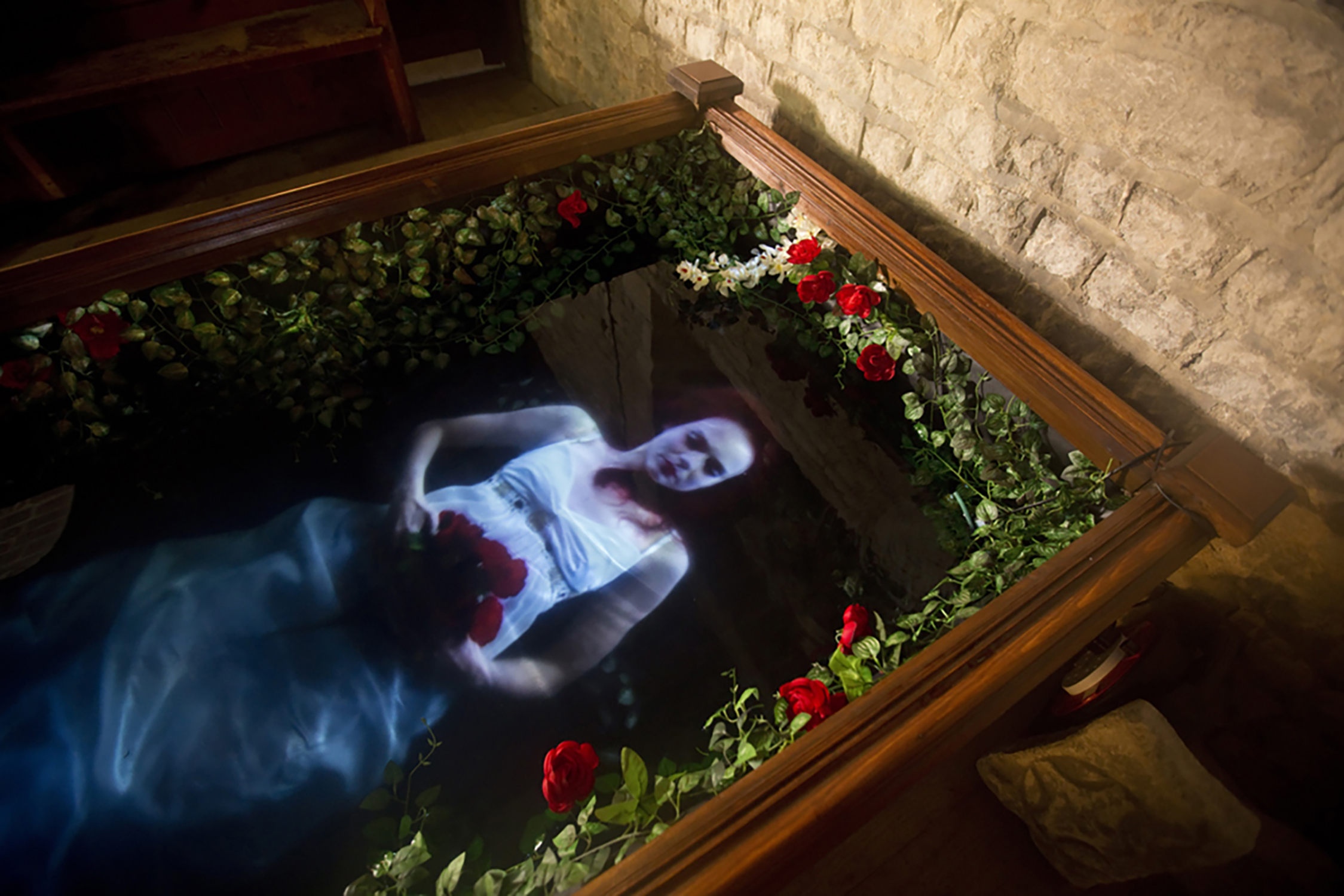
Act 2 explores the deaths of Ophelia and Lady Macbeth, and is dominated by a dark, carpeted side room featuring Davy and Kristin McGuire’s Ophelia’s Ghost (below), a holographic projection on to water. Kristin was filmed multiple times under water ‘drowning’ for this work which now looks beautiful and ethereal, the image seen through bubbling water and colourful flowers.

Ophelia’s Ghost © Kristin and Davy McGuire, photograph by Electric Egg

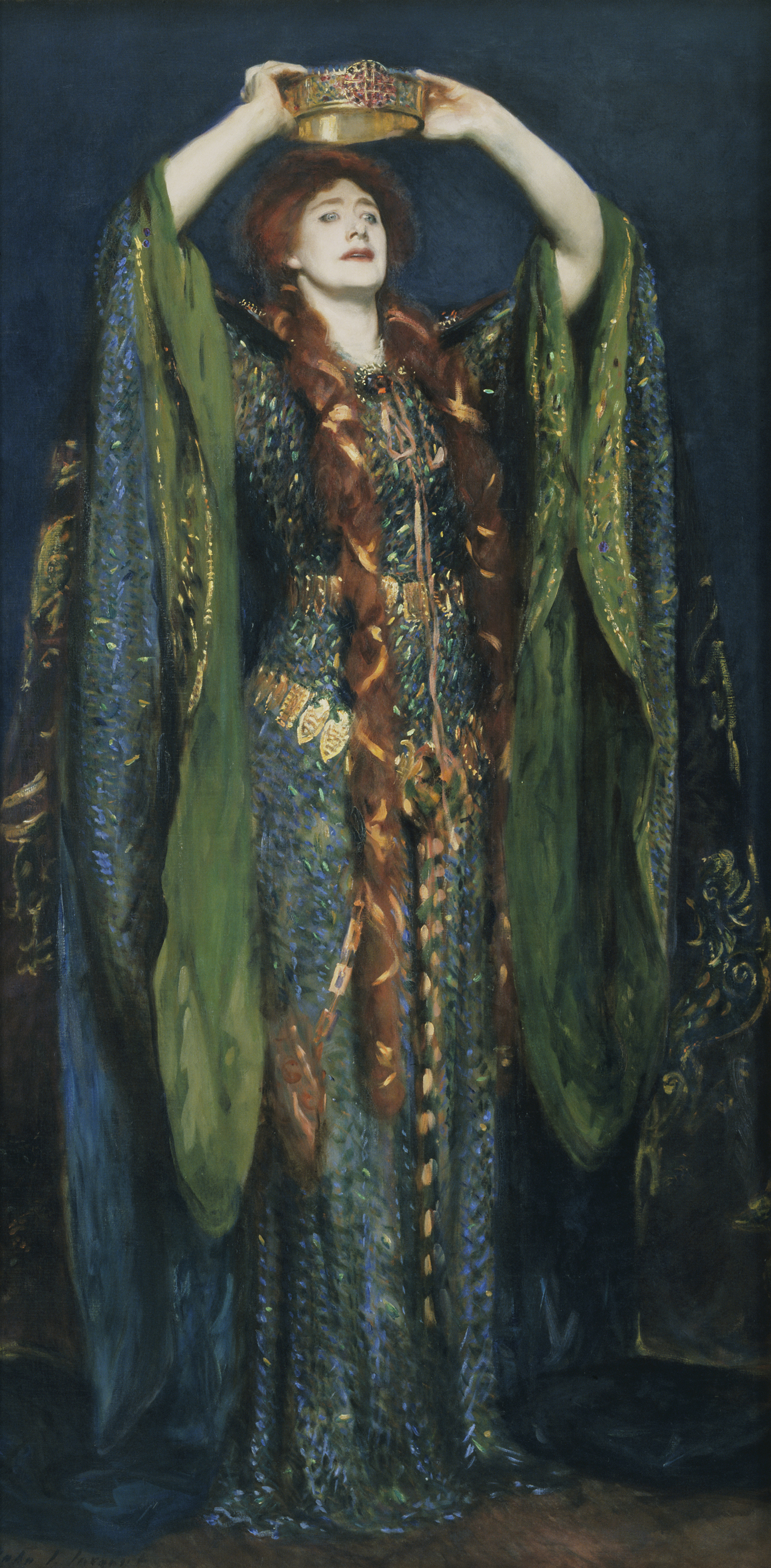
Also featured are Simeon Solomon’s Ophelia from 1887, a Rossetti drawing of Lady Macbeth and Bryan Organ’s 1973 work, Ophelia after Millais, the drawing gird marks still visible. Above them all stands the dramatic tall portrait of a crazed looking Ellen Terry as Lady Macbeth by John Singer Sargent (below). A spooky soundtrack adds to the ambience.

Act 3 celebrates the work of designer, director and writer Edward Gordon Craig, with some lovely, clean cut modernist woodcuts included. Act 4 features a new commission by Tom Hunter, in which he re-enacts Ophelia’s death in modern costume, in the Compton Verney lake. You walk below green foliage, and movements trigger audio recordings of plays in this gallery.

Act 5 shows more of his dramatic photos showing samba dancers, a thrash metal band and Pearly Kings and Queens playing roles from A Midsummer Night’s Dream; the gallery is split up with a wall with a chink in it, drawing on a line from the play.

Ellen Terry as Lady Macbeth

Ellen Terry as Lady Macbeth

Acts 6-8 features King Lear, Macbeth and Henry VIII. Henry Fuseli’s paintings from the late eighteenth century stand out for their dramatic use of light and dark, especially in The Weird Sisters and The Vision of Katharine of Aragon. A room of his work features a silver floor and moving lights.

Paired with Shakespeare in Art: Tempests, Tyrants and Tragedy, is Boydell’s Vision: The Shakespeare Gallery in the 18th Century, which examines the history of John Boydell’s gallery which opened in 1789 in London, using the Bard to develop a national form of history painting. It contains prints and paintings from that period, plus a digital re-enactment of what the gallery may have looked like.

It’s interesting, but the main exhibition can take a bow for being an appropriately and enjoyably dramatic show.

A look back at the art highlights of 2015 in Coventry and Warwickshire

As I take a rest before throwing myself bravely into a new year of trying to balance a wine glass, note book and pen at exhibition openings, there’s time to reflect on a year of varied shows – and meeting two gallery bosses called Kate who really suffer for their art.

In July, a retrospective exhibition by Coventry-based artist Nancy Upshall was my first experience of the Deasil Art Gallery in Oxford Street in Leamington. I talked to Nancy about her artistic career and paintings made in Coventry from the 1950s onwards, and also Kate Livingston and Kate Bramwell who run it.

Openings at Deasil are always fun, and Kate B welcomed me to one, when she had her hands full, by inviting me to pour my own Prosecco and “fill it to the brim” – a girl after my own heart. The exhibitions I’ve enjoyed the most have been Nancy’s and also Inked Palette, which brought a new audience to the gallery, as it showed works by people who normally work as tattoo artists. The two Kates really showed their commitment to their work at that exhibition, as each got a tattoo live at the opening – I’m glad to say I’d left by that point, though Kate B has an artist’s palette on her abdomen and Kate L a letter on her leg as a memento of it!

Adrift Adrift by Nancy Upshall

Earlier in the year, Gallery 150 bowed out of its central space in Leamington after Englandia, an exhibition by former Coventry University lecturer John Yeadon, an investigation into England’s national identity which John said doesn’t exist. I met up again with John at the Hunger Meal at Coventry Cathedral, organised by Artspace’s City Arcadia project, where we were among the naughty children, including Dean John Whitcombe, who didn’t join the organised conversations, but still enjoyed the talk and food enormously.

Rugby Art Gallery started the year in uncertain silence, with the Rugby Collection making an earlier than normal showing, including some new additions to the collection. Its later Open, fairly predictably inspired by the Rugby World Cup, was a bit disappointing but The Gain Line by Ravi Deepres was a mesmerising film which held my attention thoroughly, partly through merging local scenes from the town with a game at a huge venue.

The Mead Gallery at the University of the Warwick began the year with some fascinating Russian photographs from the early twentieth century, and by five contemporary photographers. And, not usually a huge fan of film installations, I was blown away by The Unfinished Conversation, a three-screen installation by John Akomfrah about cultural theorist Prof Stuart Hall. The summer exhibition focused on the Mead’s own collection, now in its 50th year. It was an excellent chance to see together works which are generally spread around the university.

I was also lucky enough, on a beautiful bright day, to be invited to the installation of a new work by David Nash at the University of Warwick’s Diamond Wood, accessible from the Coventry to Kenilworth cycle route and walkway. I talked to the artist as the work was painstakingly winched into place and David positioned it down to the last millimetre. It’s called Habitat and the idea is that local wildlife such as bats, birds and insects will use it; I must return to see how it’s bedded in.

The Mead’s final exhibition of the year, Making it: Sculpture in Britain 1977-1986 was a thorough and educational exhibition about the works in this period, but my overwhelming feeling afterwards was that this wasn’t the most interesting period of sculpture by a long way.

Nuneaton’s Museum & Art Gallery does a valiant job in staging two or three exhibitions at the same time, and it continued to show some small and interesting ones this year, including some inspired by works left to the museum. It started the year with an exhibition of miniatures, which revealed some lovely works by Lady Stott, who’d lived an interesting life. A later exhibition of works by Jhinuk Sarkar was inspired by a collection of items owned by Canon John Turner during his time as a missionary in Baffin Island early last century. It’s amazing where these things end up. Other good shows there this year included urban landscapes of Coventry, Nuneaton and Senegal painted by Sarah Moncrieff, and cartoons by Nuneaton-born professional cartoonist Noel Ford.

The White Room in Leamington continued to lay on fun opening nights, packing people, wine and nibbles into the small but perfectly formed gallery space.

The Lanchester Gallery had been in the prominent and easily accessible spot on a corner in Jordan Way in Coventry for the last couple of years, and flockOmania, which combined giant jewellery and performance, was one of the oddest. It’s a shame it’s now back inside the far less accessible art school building on the corner of Cox Street.

The RSC in Stratford continued to surprise with some good exhibitions, including one about Bruce Bairnsfather, the Warwickshire-born wartime cartoonist I had never heard of but was fascinated to learn about.

In In In   MichaelCarrMessagetoyourudy Foremark Reservoir IIShufflebotham

Works by Jade Blackstock, Michael Carr and Jennifer Shufflebotham in New Art West Midlands.

New Art West Midlands was challenging, not least to me when I found myself shut outside Birmingham Art Gallery & Museum desperate to get in early before a drive to Colchester (don’t ask). Thankfully PR Helen Stallard rescued me and it turned into a fun opening, with chats to several lovely artists including Michael Carr who I kept running to at exhibitions throughout the year.

Compton Verney had what felt like a good year, starting with an exhibition entitled Canaletto: Celebrating Britain, which showcased his paintings from 1746-55, and I was glad to have attended the official opening and heard gallery director Dr Stephen Parissien put them in their artistic, social and historical context.

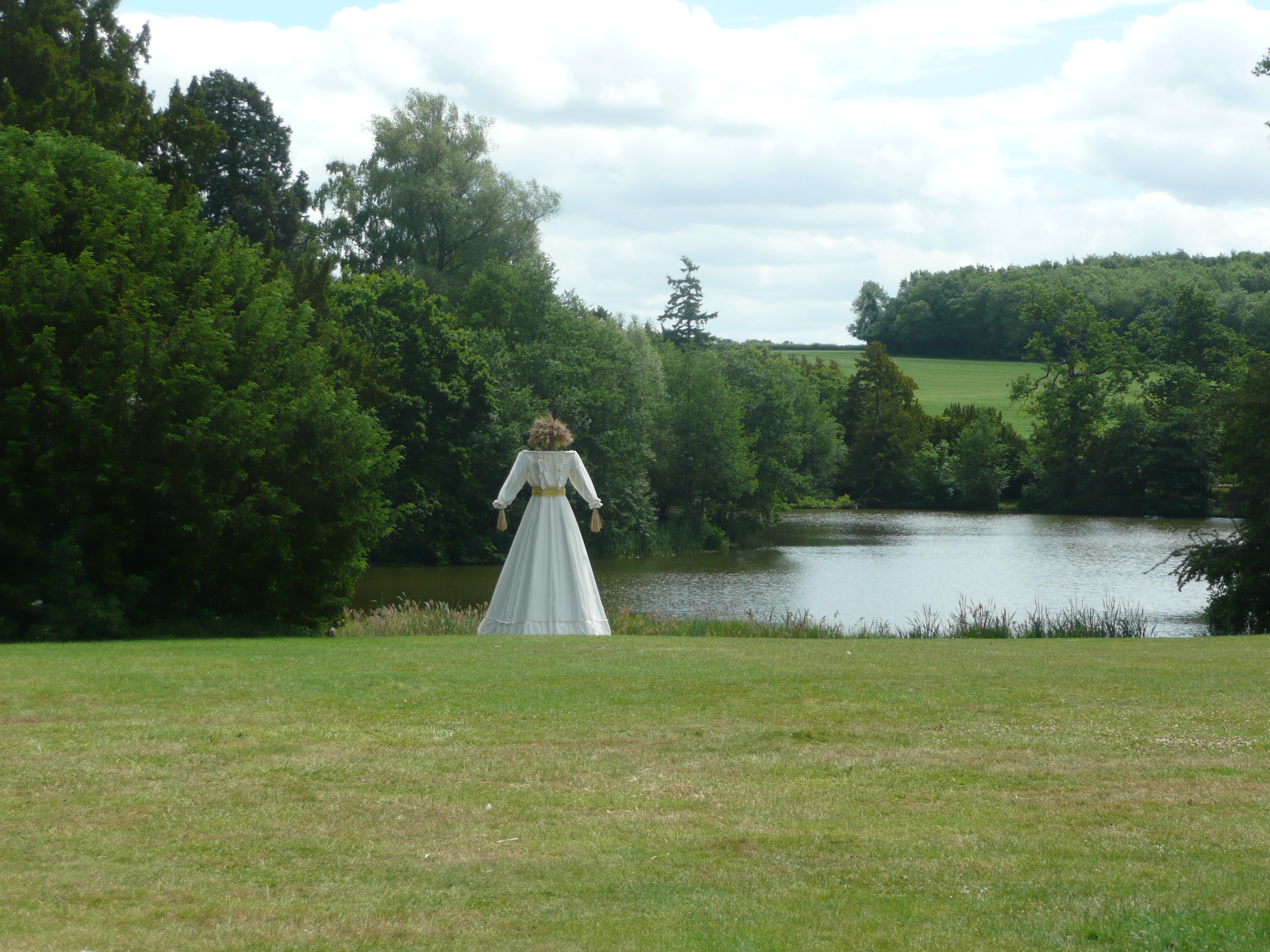
Warwickshire-based artist Faye Claridge’s Kern Baby was on show outside all season, a five metre-high faceless, gowned creature, inspired by some Benjamin Stone photographs, with some of her admittedly “edgy” photos inside. I described Kern Baby at the time as looking as though she’d escaped from the building. Months later I visited to find her down by the lake; apparently her prominent position – great as an art work – didn’t go down so well with the venue’s wedding business and photo opportunities.


P1080567


Kern Baby’s second position, by the lake.

The Chinese Collection enjoyed a big revamp after winning funding, and it made a huge difference, showing the importance of the collection rather than just being on a route between galleries.

Leamington Art Gallery & Museum held A Leamington Lad brought together lots of works by Terry Frost, 100 years after his birth in the town. It was brought to life by some recordings of interviews with the characterful Frost. Later in the year I chanced upon another Frost exhibition in Banbury, Frost, Family and Friends, showing works loaned by individuals rather than galleries, and the often personal stories behind them. The works were mostly smaller and not all in Frost’s usual style, which made it fascinating; it’s on until January 9 so there’s still time to see it.

Recording Britain at The Herbert was a V&A touring exhibition which showed the country in 1939 captured by artists of the time, and many lost scenes were recorded; it was poignant though that not all were lost in the war, some were drowned under reservoirs or lost as industries declined. The autumn season of remembrance at the Herbert included work by contemporary artists, but seeing John Piper’s paintings of the city the day after the Blitz were most memorable.

Away from my usual round of galleries, there were some other gems.

A photographic exhibition at the Belgrade Theatre showed the works of a class of 11 adults studying for City and Guild Level 2 Photography & Photo Imaging at City College, and included some really good works on the theme of city life.

Skateboarder John Blakemore

A skateboarder by Tony Skipper in the Belgrade Theatre exhibition, and a John Blakemore from Imagine Hillfields.

Imagine Hillfields was an exhibition which came from a research project, and brought together works by contemporary and historic photographers depicting Hillfields. Jason Tilley had created new portraits for it, Richard Sadler had documented his grandmother’s life in the 50s and Masterji had documented South East Asian families through the decades; but the most astonishing, by John Blakemore from the 1960s hadn’t been seen before. The bleakness of some of the images was at odds with the fizz-fuelled and fun opening.

Lucy Cash presented a film installation in Gosford Books in Coventry city centre as part of the Dance and Somatic Practices Conference 2015 which was being held in the city; about two people could squeeze in to view it at a time.

In the Michael Heseltine Gallery at Middleton Cheney near Banbury, Coventry artist George Wagstaffe, known for his sculptures, held his first painting exhibition at the age of 80-plus, and it was interesting to hear about how Pre-Raphaelite women he’d seen in paintings in Birmingham around the time of the Second World War were influencing him still.

I discovered CRW Nevinson at the Barber in Birmingham, and loved his attitudes and mix of futurist and cubist styles; the gallery showed German Expressionist prints at the same time, works which were derided by the Nazis and can be appreciated now for their honesty and power. On London visits, I discovered and enjoyed the art galleries at the Imperial War Museum.

My first visit to Bilston Craft Gallery was to see Bilston’s Happy Housing: Otto Neurath’s Vision for Post-War Modern Living, an examination of the plan for homes that would actually make people happy, and what happened to that inspirational idea.

There was an exhibition of photographs as part of Coventry University Romani Week in April, with an introductory talk by the late Deputy Council Leader Phil Townshend, who spoke passionately about the city’s dedication to community cohesion.

On a trip to Cornwall, I was amused to find lots of koans (you know, the pointy thing in front of the Warwick Arts Centre) on show at the Tate St Ives as part of a show of Liliane Lijn’s works. I didn’t get to London often this year but was very glad to make it to Ai Weiwei’s exhibition at the Royal Academy; I had thought he was more interesting as a person and campaigner than artist, but seeing lots of his pieces together made me revise that view – the personal and the political merge to create really great works. An exhibition of portraiture by Giacometti found me also having to look anew at works more on paper than in clay by one of my favourite sculptors.

One of the oddest art experiences of the year was the Art Trail run as part of the Earlsdon Festival, where I paced the streets looking for some elusive art works. It was something I felt could grow and be improved upon in 2016, but with the Earlsdon Festival now not happening perhaps it won’t go ahead at all.

Anyway – thanks for the art, the laughs and the gossiping in gallery corners this year – and looking forward to what 2016 will have to offer!

Chelsea’s ‘therapeutic’ art amongst works at new Deasil exhibition

Hide This Somewhere SafeHide This Somewhere Safe

The latest exhibition at Leamington’s Deasil Gallery features works by a number of the gallery’s artist clients.

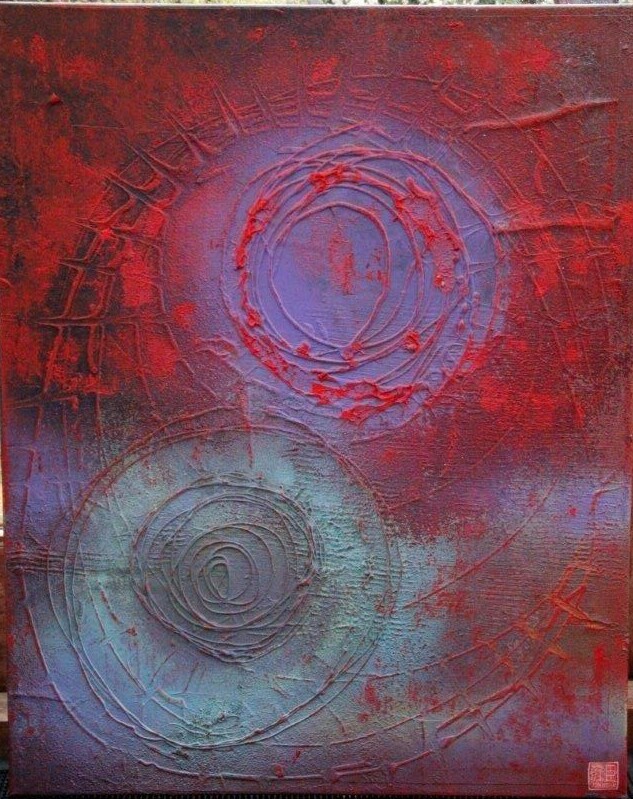
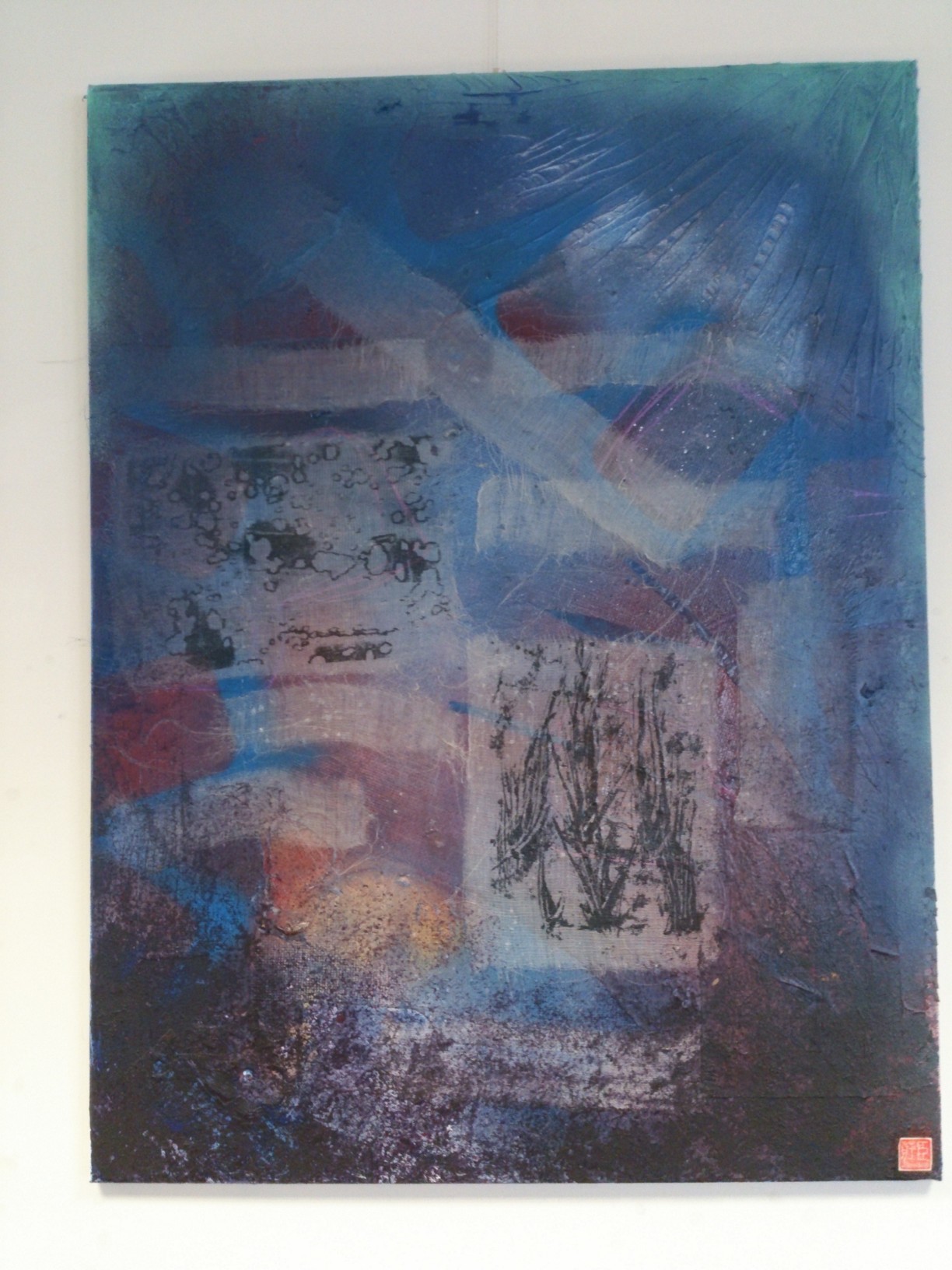
At the opening night, one artist with a tale to tell was present. Chelsea ‘Bunns’ Johnson is 24, originally from South Africa and a survivor of seven years of drug abuse. She now lives in Warwickshire though is soon to move to Coventry.

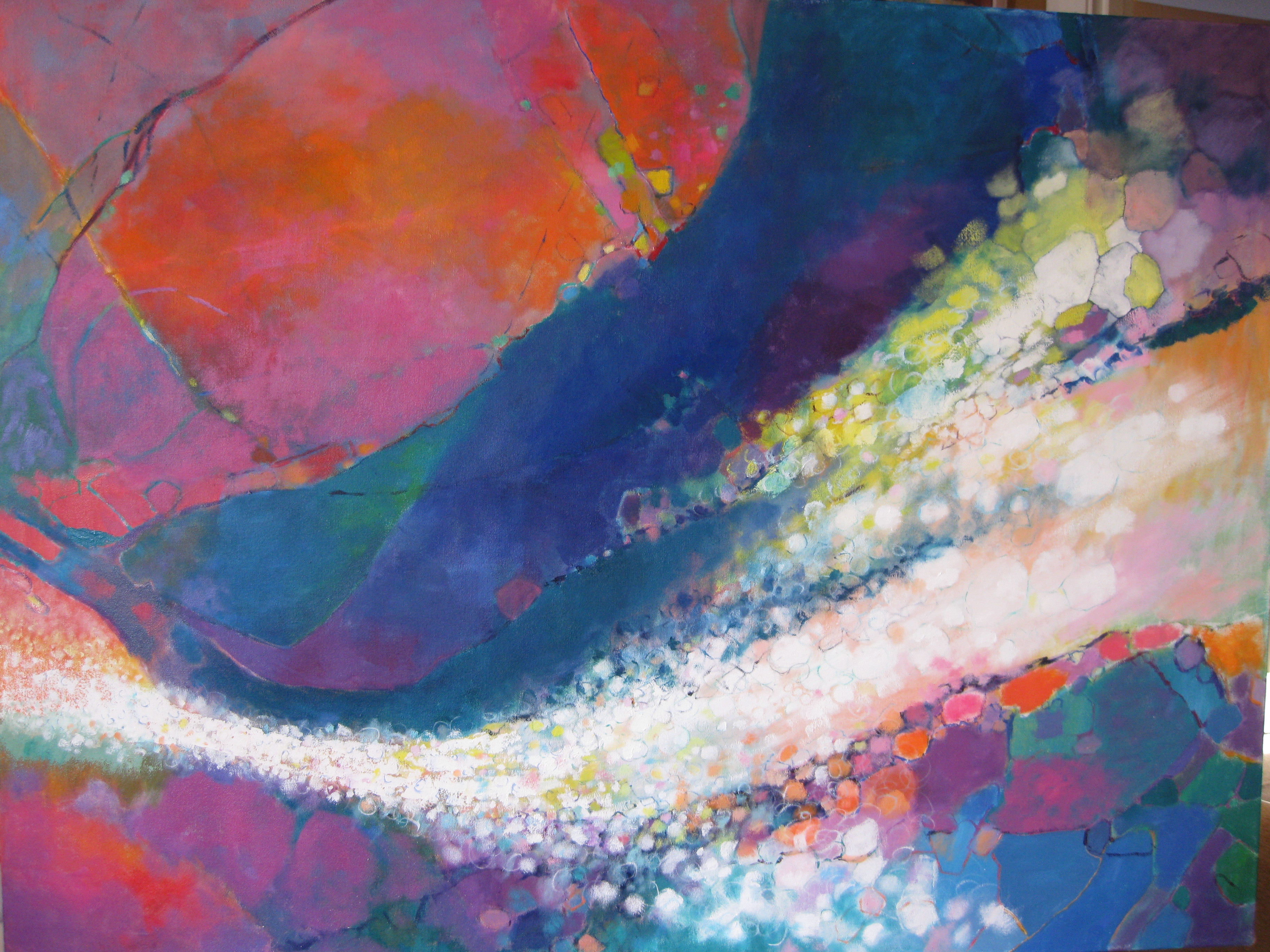
Her paintings are abstracts filled with bold colours and shapes, and often incorporating other items such as muslin and sand; she cited amongst her influences Antoni Tàpies and that interest can be seen in her work.

She said: “It’s very therapeutic for me, it’s an escape and it’s always been one constant thing in my life. It’s good to be using it to try to make a living and it’s keeping me away from the bad things – I have a very addictive personality.”

One work is entitled Hide This Somewhere Safe, and Chelsea said: “It’s when you are in that world, people grab on to you and drag you down and it’s about grab your heart and keep it safe so they don’t get hold of it.”

Get Ready To Hold Your BreathWatering My Roots “is about taking care of yourself and nurturing yourself”.  Get Ready to Hold Your Breath is right.

Chelsea’s paintings also incorporate a small stamp in the corner, made with a kit from Hong Kong her father, who still lives in South Africa, gave to her, and it reminds her of him.

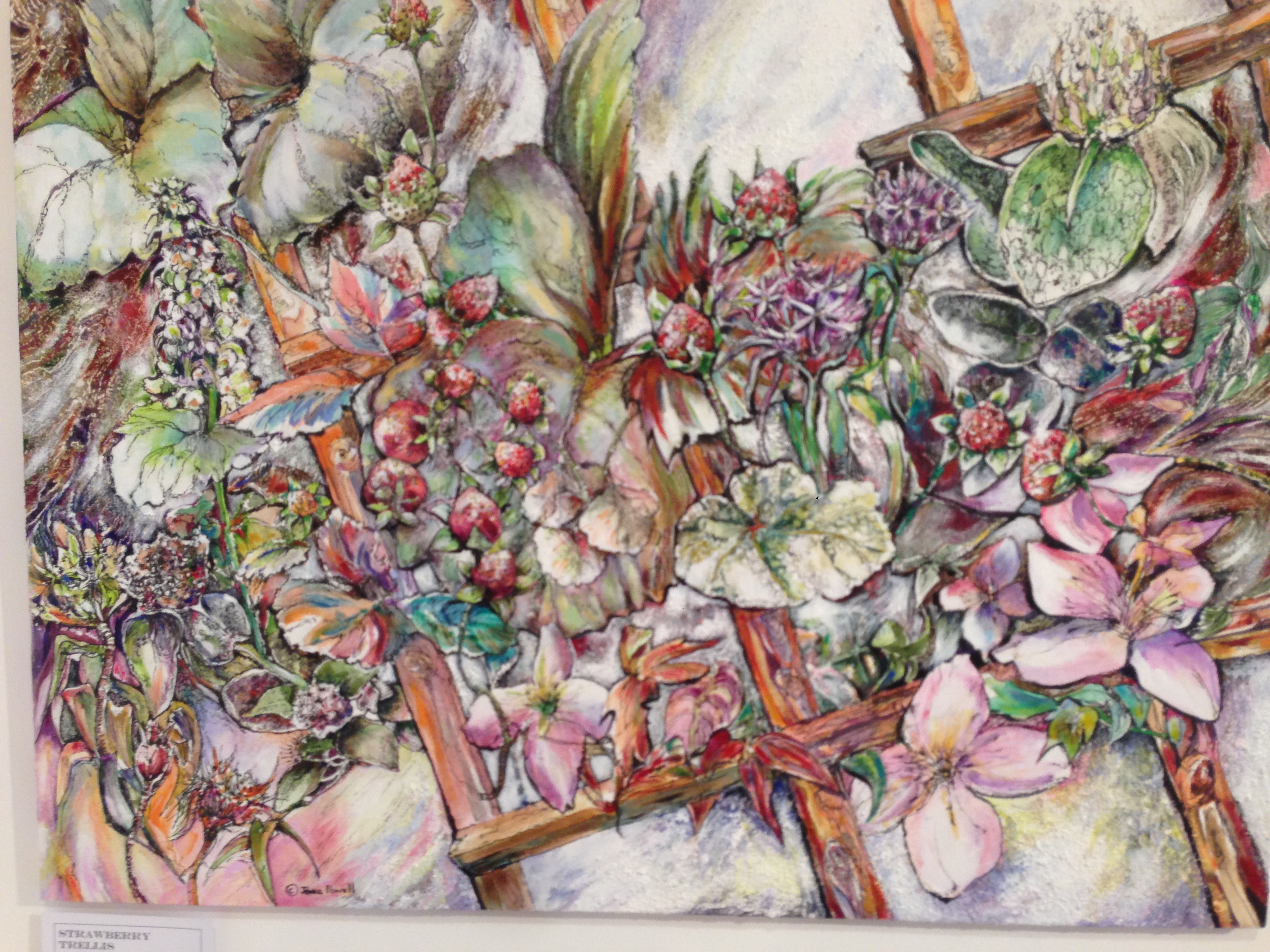
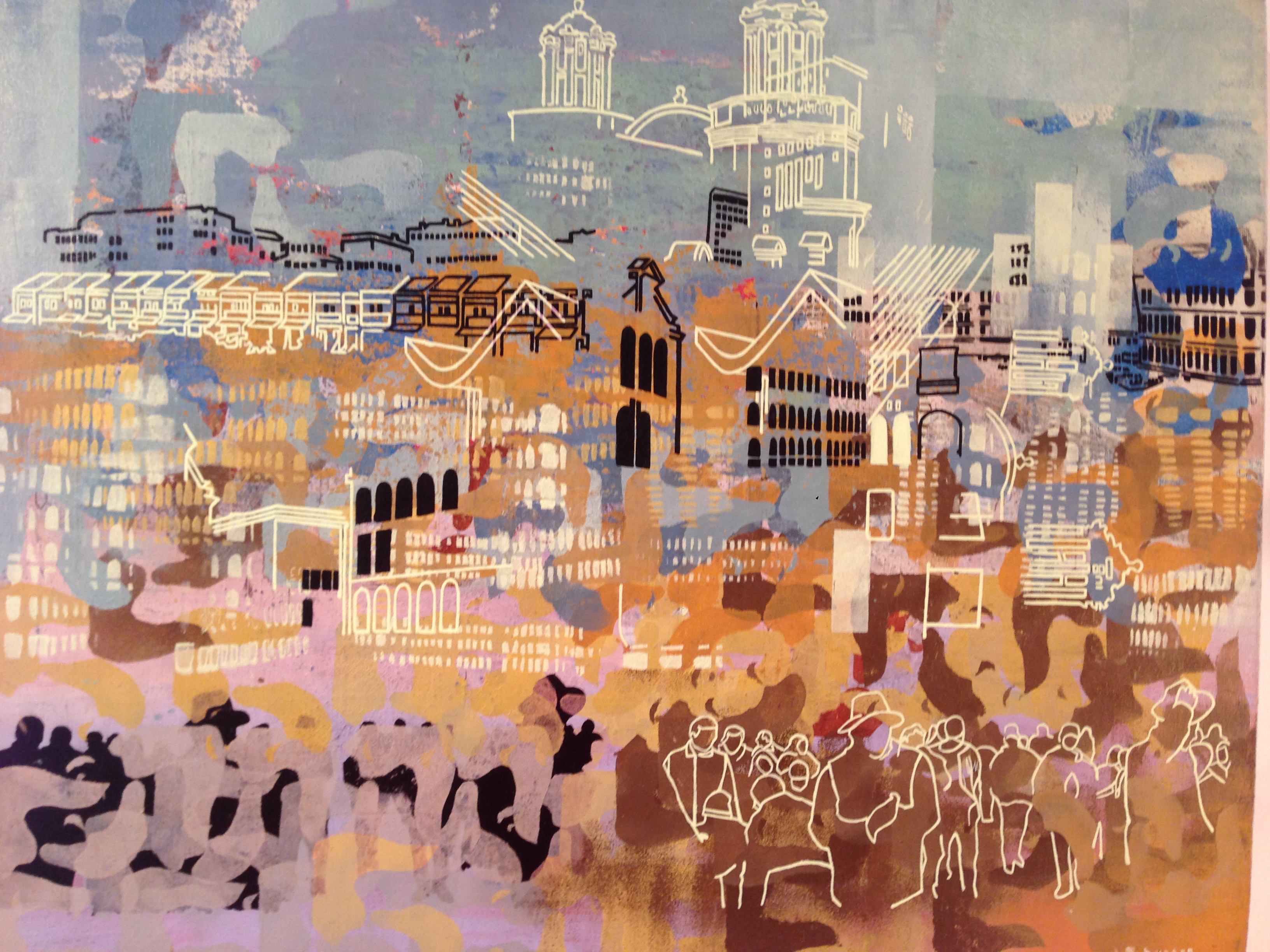
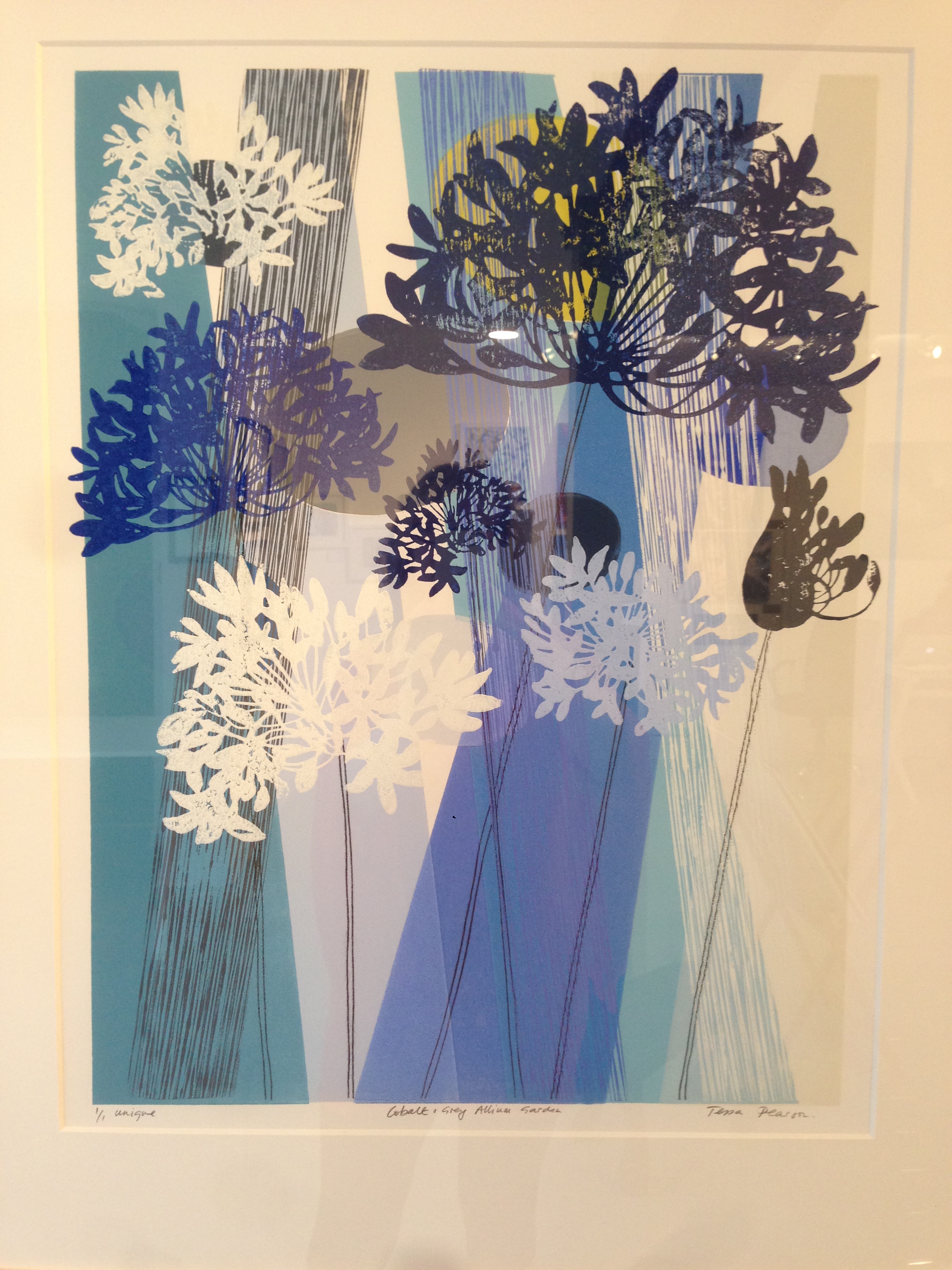
There are also very different works by other artists on show. Phil Davis’s works are detailed and bright, overlaying people and London skylines. Tessa Pearson’s show different flowers in close up, and Jane Powell’s paintings include Strawberry Trellis, a packed study of vegetation through a trellis.

Iso Bella is showing several pleasant landscape studies, and Lousie Morgan’s watercolours are tiny. Sonia Bublaitis’s Tree of Life is gold leaf on a black Perspex background.

The show is on until November 12.

IMG_1899  IMG_1900IMG_1901

Works by Jane Powell, Phil Davis and Tessa Pearson

Art in Design exhibition is stylish draw to Deasil Art Gallery

Deasil2

The creativity and talent that go into design work are the focus of the current exhibition at the Deasil Art Gallery in Leamington.

Art in Design is the title of the exhibition showing works by various artists taking in ceramics, jewellery, wood carving, furniture and lighting, plus mixed media art work.

Usha Khosla’s ceramic pieces stand out as art but also vases you could happily use, with earthy and green colours and with an unfinished, natural look to the rims.

Deasil4

David Male has used sustainable, local timber from Clifford Chambers to make a limited-edition pepper mill.

Claire Murray’s lampshades, one with a delicate pattern of a heron on it, would be a very attractive feature in the home, and Bren Boardman’s mixed media poppy and fritallaria images are also very pleasing. There are also several paintings and mixed media works by Jane Powell. Sarah Turner’s Rainbow Butterflies use the colourful metal of discarded drink cans to make attractive wall displays.

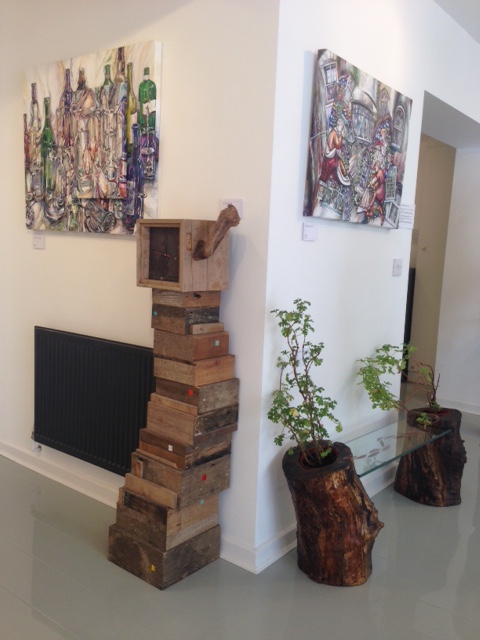
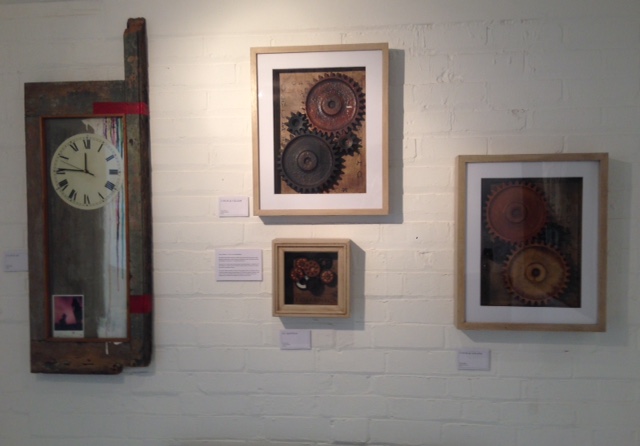
Will Morrison’s clocks, in reclaimed wood on the wall, or a pile of what looks like wooden boxes on the floor, are interesting and statement pieces. Steve Johnson’s wall-shown works are a mixture of cogs and gears, internal workings brought out of machinery to be the centre of attention (both above).

Deasil3

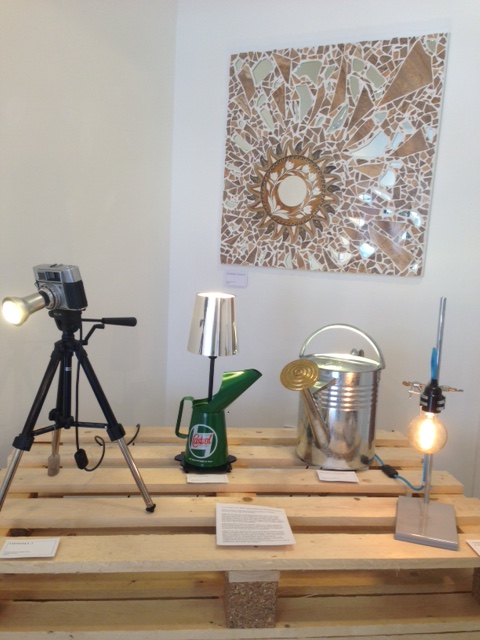
Michael Grassi’s lights illuminate one corner, made from unlikely items including a camera (above).

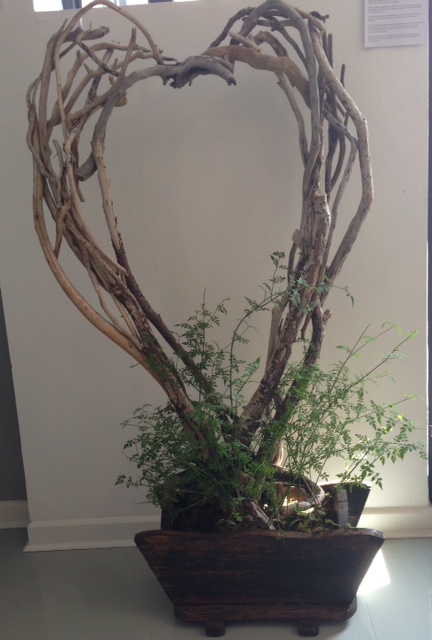
Jason Willis’s driftwood and greenery combinations (below)would look good in a corporate or hotel setting, and Dominic Gubb’s reclaimed leather and furniture leg models of a bulldog and pug dog raised a smile and would make a statement in the right place.

It’s another interesting and varied exhibition from the Deasil Gallery which is on show until September 10.

Deasil1


Fascinating Imagine Hillfields exhibition depicts changing post-war life in Coventry suburb

John Blakemore

An exhibition which is part of a research project has drawn out some amazing never-seen-before photographs of the Hillfields area of Coventry, and added in some new pictures.

The Imagine Hillfields Exhibition is on at the Box in Fargo in Far Gosford Street, Coventry, until the end of the month. It is part of a project of the same name run by a team of sociology researchers from the University of Warwick which in turn is part of a national project looking at the way society imagines its present and future.

There are work by five photographers on show, all showing post-war Hillfields. John Blakemore (one photo top), born in 1936, had wanted to be a social documentary photographer, and his photos from the early 1960s have never been seen before. They are quite astonishing, some looking much older than they are, especially a chimney sweep and his wife in their home with the wallpaper hanging off damp walls.

In many labelled Urban Playground, children play amongst rubble and a terraced street stops dramatically with a gap where a house once stood. In Eric Green’s Triangle lots of terraced houses disappear into the grey background and in another a cheery shopkeeper, cigarette in hand, smiles for the camera. There is a young child in a mosque, and a Sikh family walking down Primrose Hill Street, reminding us Coventry has been welcoming new people for a long time.

Richard Sadler

Richard Sadler, now 87, used to photograph celebrities visiting Coventry, but his pictures on show here document a day in the life of his grandmother, Minnie Sadler (one image above), who lived in Hillfields. She’s seen sitting on the edge of the bed in her tiny attic room, all tussle haired, then looking much smarter when done up. She’s seen washing the doorstep, like a good 1950s woman, going shopping, pictured artily from behind a street display of prams, and having tea. There’s also a little boy dressed as a sailor at the Coronation celebration.

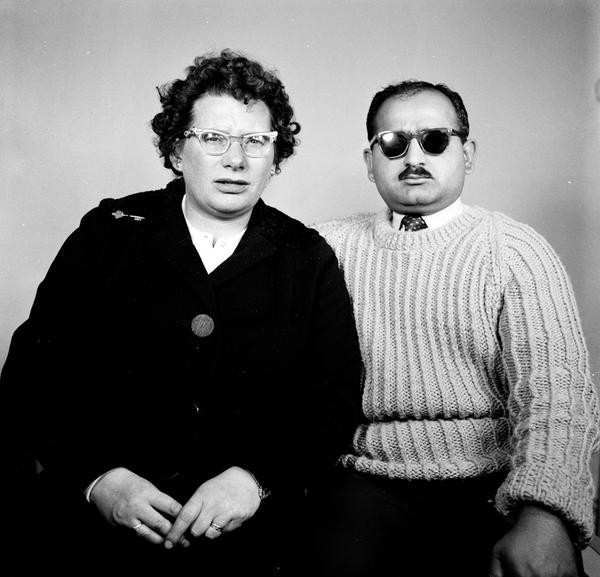
MasterjiMasterji, now 91, came to England from Mumbai in 1951 and became the owner of Master’s photographic studio in Stoney Stanton Road. His images are all portraits of South East Asian families through the decades, and so document changing fashions and styles. There’s strict moustaches on men in 1965, and a more laid –back cool look in 1975. A Sikh family pose in their own home, husband and wife either side of the big TV also in 1975, and Indian weightlifters with long hair show off their muscles at Sidney Stringer School. They are all very atmospheric (one image right).

Jason TilleyJason Tilley, former Coventry Telegraph photographer, has created new works in response to the Blakemore ones, showing in vivid colour portraits of the varied population of Hillfelds today, often looking away from the camera in the street, or proudly outside their own homes, showing the continuing changing make up of the population (image left).

In the entrance area, Nick Stone’s photographs use ghosting to merge old pictures, including a horse-drawn drinks cart, with photos of the area now to show change and continuity in one.

It’s a fascinating exhibition and essential viewing to those keen on photography, social history and Coventry.


Excellent Nancy Upshall exhibition puts Deasil gallery on the map

Adrift

A Coventry-based artist is holding a retrospective of her work with paintings and drawings going back to the 1960s.

Nancy Upshall moved to the city from Dorset to teach art at the then Barkers Butts School in the 1950s.

She said: “I left my first job very easily – I was teaching art and they had a polished floor in the art room and the caretaker would grumble (about it getting dirty) so I gave my notice in. After about two months I thought I better get another job and when I applied for Coventry I thought that’s the furthest north I am going to go. It was a secondary modern school, and they had been told by an inspector their art and music was useless. They wanted to get a graduate in and I thought when I was being shown round, this job is mine!

“I came from a small town in Dorset and coming to Coventry it was so industrial … I couldn’t believe people lived like that, it was a real eye opener for me.”

Nancy thought she might stay in Coventry for a couple of years, but then, as she put it, “love struck” and she has been in the city ever since.

A few of the works in the exhibition are from the early years. Nancy said: “Some of them go back quite a time, and some of the early ones are from when I was first married and living in Coventry.”

She recalled going out on a Sunday morning when she only had her first daughter, Jane, and Nancy would draw and Jane took her drawing book along too, but it got too complicated by the time her second daughter came along.

The post-war reconstruction was going on in earnest. She said: “I remember being on the roof of Broadgate House and painting – there’s one in the Herbert in Coventry which I did of Smithford Street.

“There were car parks which for me were ready made abstracts, you got a space and beyond it another space.”

Now retired but still painting in Earlsdon, Coventry, Nancy taught for many years at Coventry Technical College, a Lanchester Polytechnic annex, Rugby School of Art and until recently on open studies classes at the University of Warwick.

This exhibition at the recently-opened Deasil Art Gallery in The Warehouse in Oxford Street, Leamington, has around 50 paintings, prints and drawings on the walls, plus 70 prints in racks.

The early works include a pen and ink drawing of the Owen Owen building being constructed, with the old stone of Holy Trinity also visible, from 1962, and a painting of the rebuilding made of lots of bright squares from 1964. Portrait of Greta, a delicate close up of a woman with a beehive hairdo is also an early work from 1962.

Later works develop her familiar wide palette of colours, usually including purples. Some works are entirely abstract, others more figurative but in the same colour-filled style. Others stand out as very different.

Mind the Gap from 2004 has what looks like a large cut-away bit of earth so you can see what’s below ground, while the words ‘mind the gap’ are repeated and fall into a hole. Not Waving but Drowning of 1976 is a rather symbolic pencil drawing showing a small hand waving from behind a curtain in a house, which in front of it has a hedge and two fences. Green Belt of 1981 is a larger-than-normal work with a green bit in the middle, dividing many overlapping pencil-drawn houses.

Le Plongeur

There are also a few works inspired by a visit to Ayers Rock in Australia in the 1990s, including Tree Ancestors, a delicate screenprint of strange-faced creatures.

Geranium from 1980 is an identifiable plant, and Inkwells from 1983 uses what is now a flaking orange paint as the background colour, with three inkwells painted on. Other more abstract works feature brightly coloured shapes and swathes of colour, some in series like the Division series of 2007, or the large Rift from 2004. And it’s good to see Nancy’s still working, as the Poseidon’s Kingdom, with what look like watery bubbles, from 2015.

It’s a wide-ranging exhibition from an interesting and popular artist which shows the variety of her work from over the decades, in a pleasant, fresh-looking space which plans to show new exhibitions every three weeks.

The retrospective is the third exhibition at Deasil Art Gallery, a pleasant, clean-looking space on the ground floor of what was Oceans nightclub, and is now occupied by creative businesses,a design company and social media firm.

Deasil is run by Kate Livingston and Kate Bramwell, and the name Deasil apparently comes from the meaning of the direction of the sun’s movement clockwise, moving forward, to tie in with the Kates’ aim of being an Art Agency and displaying art in different venues across the Midlands – moving art forward. I look forward to hearing more from them, and seeing what other exhibitions they put on in the future.